



We’re on a mission to make ANNA more accessible for everyone in 2026 and we’ll be sharing every step of our journey here.
At ANNA, we’ve always believed that anyone should be able to run a business confidently, no matter their background, language, or experience. Our aim was always to build a product that was easy for people to use, that didn't leave people behind. But, over the past year, we’ve realised that having an inclusive product isn’t just a nice‑to‑have – it’s essential.

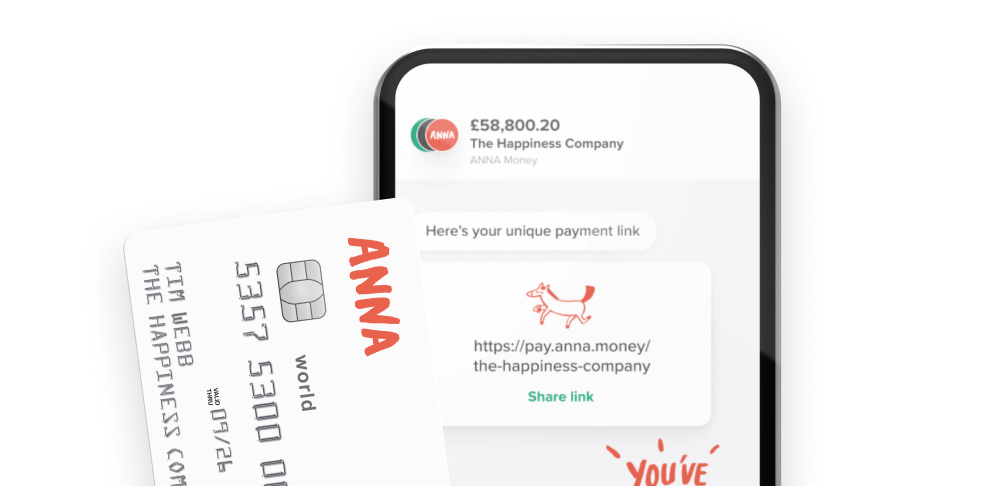
The spark came from content creator and inclusivity advocate Isaac Harvey MBE, 30 from East London, who has a disability called limb pelvic hypo-aplasia meaning he has no arms and short legs, scoliosis, a weak pelvis, which means he’s not able to walk and, on top of all of that, has acid reflux.
The wake up call
Isaac wasn’t on our radar – he was an ANNA customer but we’d never met him, until he just happened to talk about using ANNA in a film for Project Nemo (a UK-based, non-profit initiative aiming to accelerate disability inclusion in the fintech and financial services industries).
Watching Isaac show just how easy he found it to use ANNA with its chat-based functionality was very surprising and moving. To see something you designed and built make life just a little bit easier for someone who faces so many challenges was very emotional. And it was a powerful lightbulb moment – maybe more like a lightning bolt jolt – for our team.
“Thanks to Isaac, we woke up,” says Andy Moore, ANNA’s Head of Product Design. "We'd accidentally built something accessible through our chat interface, but we'd never been intentional about it. Watching him navigate ANNA with his feet made us realise: if someone can't use your product, that's a design failure, not a user limitation. Isaac's story became our turning point – the moment we stopped stumbling into accessibility and started designing for it."
First steps
One of the first things we did was get in touch with Project Nemo and ask if they might introduce us to Isaac. Jo Dewar from Project Nemo invited us to see Isaac and Kris Foster (Co-Founder at Project Nemo and Co-Founder of Open Book) in a fireside chat at a Google fintech event. We met Isaac, met Kris, and had some very arresting conversations.
Andy recalls: "I'll never forget what Kris asked me, Do you talk to your customers?' Yes, constantly, I told him. 'How many of them have disabilities?' Silence. I genuinely didn't know. We'd been talking to customers for years, but we'd never asked that question."
We'd been talking to customers for years, but we'd never asked that question.
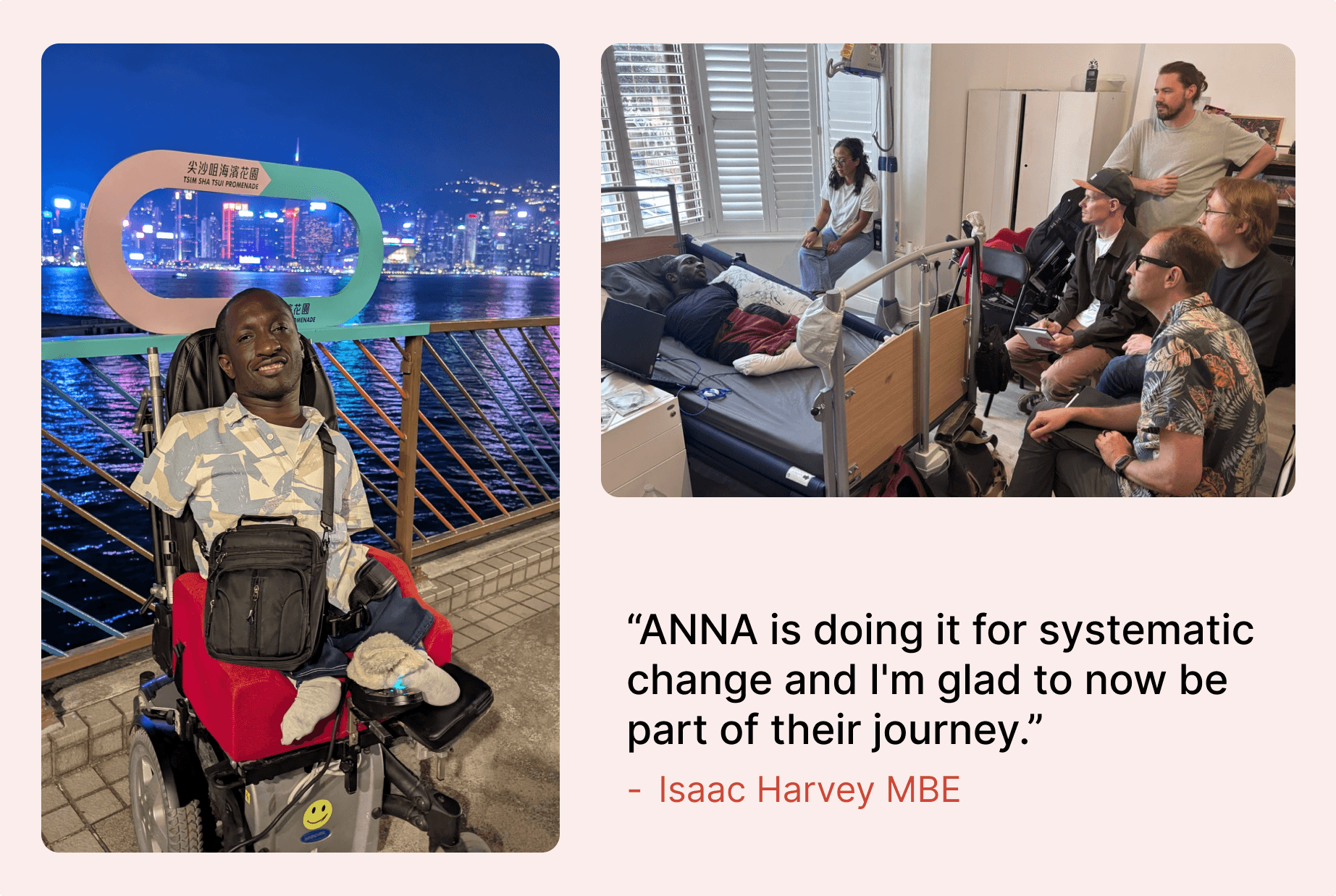
So we asked Isaac if we could visit him in his home and observe how he used ANNA, and his set up working from his bed and using his toes to type. We asked questions about what we could change to make the app easier to use for him, we listened.
We were so blown away by Isaac that we invited him to the ANNA offices in Kings Cross for a fireside chat (admittedly the fire was a YouTube video on the TV) so he could meet more of the team and speak to our engineers, designers, CX team and tech teams about his lived experience.
“It still surprises me today, how this all came about from saying ‘yes’ to be part of the Project Nemo video series,” says Isaac. “From using an app that worked for my needs, to being invited into their offices to talk about my lived experience is something I was not expecting. The real turning point for me is how the ANNA team – especially Andy – has said that they are not doing this for social media and want to do it because they believe in change. Some companies do it for the clicks but ANNA is doing it for systematic change and I'm glad to now be part of their journey.”
The backstory
A few years ago we did a workshop on product principles and one customer’s comments really hit home and stuck with us. Zoe's feedback was: “This is a little jewel at my fingertips, especially having challenging learning difficulties”.
"That hit differently,” says Andy. "We weren't just making business finances easier – we were removing barriers we didn't even know existed. Our customers were basically saying our product strategy back to us, but they were also telling us something bigger: we'd accidentally built something inclusive."
We weren't just making business finances easier – we were removing barriers we didn't even know existed.
To be transparent we built chat to make it more usable, not specifically with inclusion in mind. But inadvertently we made it more accessible than the typical business account product that uses lots of menus and drop down forms. So we’ve always had a roadmap of understanding what the problems are, and solving them.
In future, we’ll have a continuous dialogue with people with diverse access needs and we’ll be baking inclusion into everything we're doing. The target is that, over time, we’ll be able to say that we're an inclusion-first company.
Innovation by inclusion
It’s clear just how important this is. A sizable portion of the small‑business community is often overlooked: around 25% of small business owners have some form of disability, and 15–20% of the population is neurodivergent. Many of these people turn to entrepreneurship precisely because traditional jobs don’t work for them. For these people, running their own business isn’t a hobby or a lifestyle choice – it’s the only viable path when mainstream workplaces are built without them in mind.
Project Nemo’s mission is to highlight that the financial services industry is particularly poor when it comes to inclusion, and to show just how much of a negative impact this has on people trying to live independent lives with accessibility issues.
These insights reshaped our priorities and sharpened our focus. Accessibility isn’t a side project or marketing talking point. It’s central to who we are and who we want to serve. Anybody can have a business that thrives with the right sort of tools. We want to remove every barrier to financial empowerment so no one feels left out, lost or left behind.
Accessibility is a design issue, it shouldn’t be an accommodation. Our product is 7-years in the making so some things we will have to tweak retrospectively, but ANNA is also constantly evolving as we offer more services and move towards being a single platform you can run your entire business from – from payroll to filing taxes. Anything new will now have inclusivity hardwired into it from the beginning.
Design for the edges, and you get the center for free. That's the ‘curb cut effect’ (where high curbs are replaced with flat, paved areas where lots of people cross) – a change made for wheelchair users that ended up making life easier for parents, delivery drivers, travelers, runners, cyclists – basically everyone. We're applying that same principle to finances, admin and accounting. When we make ANNA work for someone with access needs, we make it clearer for everyone.
We call it innovation by inclusion. Build voice input for someone who can't type, and suddenly every parent doing invoices while cooking dinner benefits. Design focus mode for someone with ADHD, and every founder drowning in notifications gets a better product.
Accessibility isn't a separate track – it's how we make ANNA better for everyone.
Our plan
Because we want to do this properly, and we’re building our plan thoughtfully and carefully:
Now: Understanding Our Customers' Needs
We're starting with a survey of existing ANNA users to understand how many have access needs and what those needs are. This helps us design better testing, recruit the right panel members, and prioritise improvements based on real data, not assumptions about who our customers are.
Early 2026: Find Out What's Actually Broken
We'll test ANNA with users who have diverse access needs – observing where people struggle and what workarounds they've created. We'll document everything, including video footage that shows our team what barriers look like in practice, not theory. This comes before building anything new because understanding what's broken now prevents costly mistakes later.
Q1-Q3 2026: Build Empathy, Not Just Compliance
Technical training teaches you what Web Content Accessibility Guidelines (WCAG) mean. It doesn't teach you what it feels like to be locked out. We're bringing users in for direct conversations between our team and people with lived experience. These create the "aha moments" that change how designers think long after the training ends.
Q2-Q4 2026: Keep the Conversation Going
We're building a customer panel that mixes regular members with rotating new voices – avoiding the trap of the same small group becoming an echo chamber. They'll test new features, co-design solutions, and give quick feedback through whatever communication tools work best for them.
AI will help us break down barriers
And because we're an AI-native company, we see opportunities others don't. "AI lets us build accessibility in rather than bolt it on," says Andy. "We can rewrite content in realtime in a language the user understands. We can adapt interface complexity based on how someone's using the product. We can offer voice interactions across multiple languages. These aren't separate 'accessibility features' – they're intelligence that makes ANNA work better for everyone.
"That's what's genuinely exciting about this work. We're not just meeting compliance standards. We're building a product that adapts to people, rather than forcing people to adapt to it."
AI lets us build accessibility in rather than bolt it on
Why we’re doing this open source – and we hope others will too
We’re not doing this to tick a box. We’re doing this because fundamentally we want to build a better product. And because we believe that sharing our journey – bumps in the roadmap and all – can help others learn too. That’s why we’re going open source with this.
If you’re building a product, a service, a platform – whatever it is – and you care about real inclusion, we’d love to talk. Let’s swap lessons, share insights, and make sure that accessibility isn’t an afterthought.
If you’d like to join us on this journey, or share ideas or feedback, get in touch at nobarriers@anna.money
Let’s build a world where there are truly no barriers to doing business.
Read the latest updates
![Making Tax Digital Costs: What Will MTD Cost You? [Breakdown]](https://storage.googleapis.com/anna-website-cms-prod/small_cover_3051_a896b063b0/small_cover_3051_a896b063b0.webp)
![Offshore Company Registration in the UK [2026 Guide]](https://storage.googleapis.com/anna-website-cms-prod/small_cover_3000_cdb14668f7/small_cover_3000_cdb14668f7.webp)
![What Is Process Automation in Accounting? [Explained]](https://storage.googleapis.com/anna-website-cms-prod/small_cover_3000_12_7b691ef177/small_cover_3000_12_7b691ef177.webp)
![How Will Automation Affect Accounting in 2026? [Full Guide]](https://storage.googleapis.com/anna-website-cms-prod/small_cover_3000_11_514d5404c1/small_cover_3000_11_514d5404c1.webp)
You may also like


Open a business account in minutes
