
The 2026/2027 Tax Year Calendar for LTDs [UK Full Guide]


Discover everything you need to know about the UK tax year including key deadlines, compliance requirements, and essential filing obligations.


In this article
- Key points
- 2026/27 tax year for LTDs
- Key tax deadlines compliance calendar (2026/27)
- Key tax deadlines for LTDs (2026/27)
- Corporation tax deadlines for LTD companies
- Companies House filing requirements for LTDs
- Annual accounts filing penalties
- PAYE and payroll deadlines for LTDs
- VAT registration and filing obligations
- Salary and dividend planning for LTD directors
- 2026/27 Dividend tax rates
- How ANNA helps limited companies handle taxes with ease
- FAQ
Running a limited company in the UK involves juggling numerous deadlines, including Corporation Tax, PAYE (Pay As You Earn), VAT, annual accounts, dividend planning, and other financial obligations.
Falling behind on any one of these can lead to fines, stress, or worse: your company getting struck off the register.
This comprehensive guide walks you through everything you need to know for the 2026/27 tax year, tailored specifically to LTD directors.
Key points
- Your accounting year affects your tax planning 💼
Your accounting year doesn't have to match the personal tax year, but choosing the right year end can make it easier to manage your obligations. - Don't overlook Companies House filings 🏢
Filing annual accounts and a Confirmation Statement is a legal requirement, even if your company is dormant or no details have changed. - Plan ahead for taxes 💷
Setting money aside throughout the year and keeping accurate records makes it much easier to pay all your taxes on time. - Use ANNA to simplify compliance 🚀
ANNA helps you stay on top of everything, so you can spend less time on admin and more time growing your business.
2026/27 tax year for LTDs
The UK personal tax year runs from 6 April 2026 to 5 April 2027. Your LTD’s accounting year, however, is typically based on your incorporation date and financial year-end. This is known as your Accounting Reference Date (ARD).
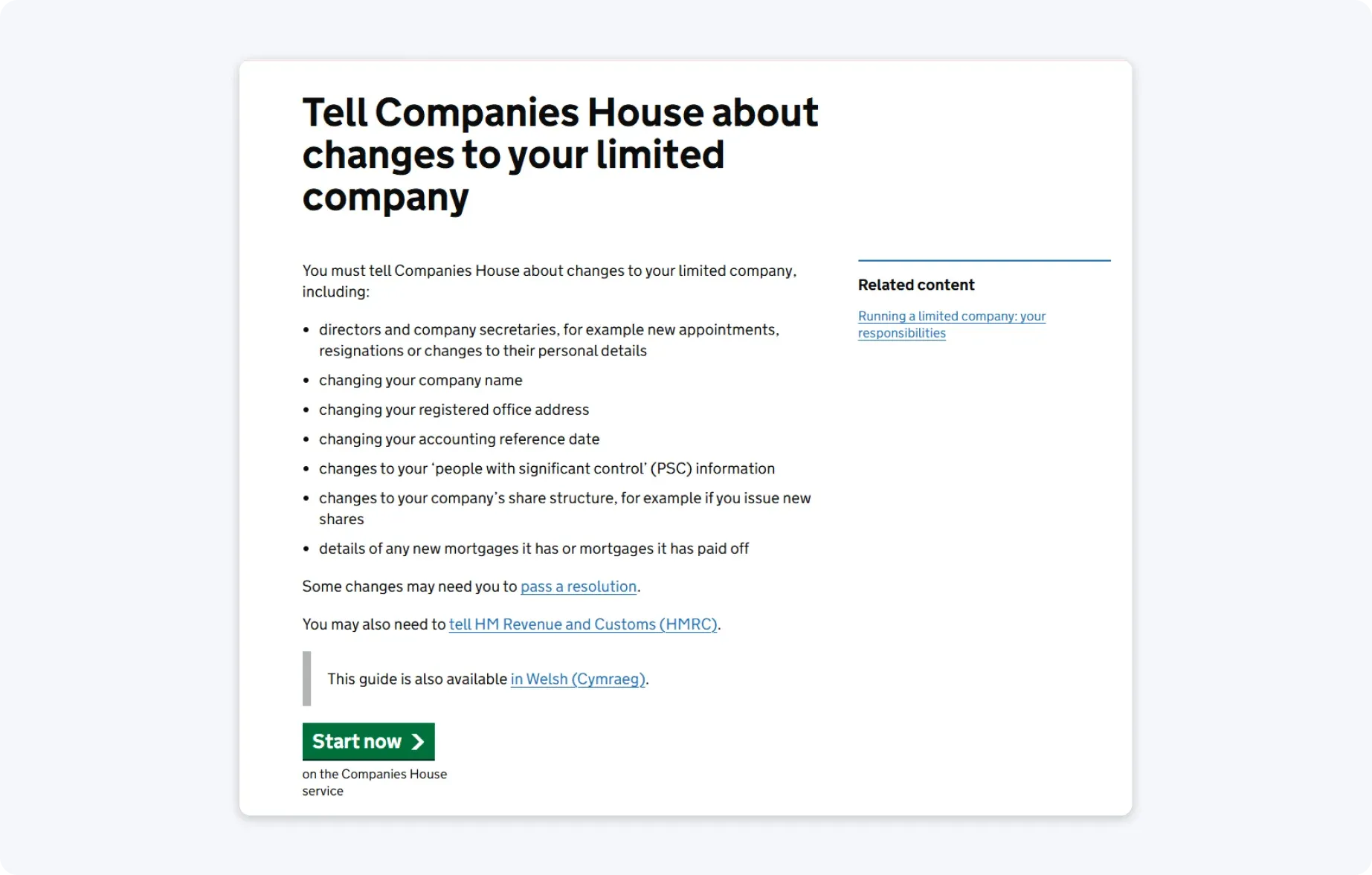
You can change your ARD, but you must inform Companies House.
HMRC’s Corporation Tax deadlines follow your accounting period, which may not match the tax year.
Aligning your accounting and tax year
Consider aligning your accounting year with the tax year for simpler planning. This can make it easier to manage dividends, Self Assessment, and Corporation Tax.
To align your accounting year with the tax year:
- Log in to Companies House WebFiling
- Navigate to your company profile and choose "Change accounting reference date"
- Select a new date that ends on or around 5 April
- Submit the change. You’ll receive confirmation when the update has been approved
Important rules:
- You can shorten your accounting period as often as you like.
- You can extend it once every five years, unless granted special permission.
💡 Why this helps:
Aligning the ARD with the tax year streamlines reporting. It keeps salary, dividends, expenses, Corporation Tax, and Self Assessment all within one annual window, making record-keeping and year-end planning much easier.
Key tax deadlines compliance calendar (2026/27)
Here’s an overview of all the key dates for 2026/27:
Key tax deadlines for LTDs (2026/27)
| Deadline | What It’s For | Who It Applies To | How to Handle It |
| Monthly (each payday) | Submit FPS (Full Payment Submission) | All LTDs running payroll | Use payroll software to file Real Time Information (RTI) to HMRC on or before payday |
| Monthly (22nd) | PAYE and NIC payment (electronic) | All LTDs running payroll | Log in to HMRC and pay electronically |
| Quarterly orAnnually | VAT return and payment | VAT-registered LTDs | File via MTD-compliant software within 1 month + 7 days of period end |
| 6 April 2026 | Start of personal tax year | All company directors | Review salary/dividend strategy based on updated thresholds |
| 31 May 2026 | Give P60 forms to employees | All employers | Generate via payroll system and distribute |
| 6 July 2026 | Submit P11D/P11D(b) | LTDs providing benefits-in-kind | File online and ensure accuracy for Class 1A NICs |
| 22 July 2026 | Pay Class 1A NICs | LTDs with benefit-in-kind liabilities | Pay through your HMRC PAYE account |
| 5 October 2026 | Register for Self Assessment (if new) | Directors needing to file a return | Complete registration via gov.uk |
| 31 October 2026 | Paper Self Assessment deadline | Directors filing by post | Post to HMRC by this date |
| 31 January 2027 | Online Self Assessment deadline & payment due | All Self Assessment filers | File online and pay any tax due |
| Accounting Year-End +9 months | File annual accounts with Companies House | All LTD companies | File online or via accountant (e.g. 31 Dec 2026 year-end = 30 Sept 2027 filing) |
| Accounting Year-End +9 months +1 day | Pay Corporation Tax | All LTDs with profits | Pay by bank transfer or online (e.g. 31 Dec 2026 year-end = 1 Oct 2027 deadline) |
| Accounting Year-End +12 months | File Company Tax Return (CT600) | All LTDs | Submit CT600 with full accounts and computations |
| Anniversary of Incorporation +14 days | File Confirmation Statement | All LTDs | File via Companies House; check for changes to officers, PSCs, or shareholdings |
Corporation tax deadlines for LTD companies
Corporation Tax is one of the most important responsibilities for a limited company. If you're a director, it’s essential to know exactly what to do and how to avoid penalties.
Step 1: Register for Corporation Tax
Deadline: Within 3 months of starting business activity (not necessarily incorporation).
What counts as business activity?
- Selling your first product or service
- Advertising or marketing your business
- Employing staff
- Renting an office or workspace
How to do it:
Companies are now automatically registered for Corporation Tax when they incorporate, so you no longer need to register separately.
After incorporation, HMRC will send your Unique Taxpayer Reference (UTR) and information about your Corporation Tax responsibilities to your company’s registered address.
💡 Why this matters:
You won't receive reminders or filing notifications from HMRC unless you're registered. You also risk late-filing penalties if you miss deadlines.
Step 2: Pay Corporation Tax
Deadline: 9 months and 1 day after your accounting period ends.
How to pay:
- Log into your HMRC business account
- Pay by bank transfer, Direct Debit, or card
- Keep a record of the payment date for your files
Late payments incur interest and may impact future HMRC relationships.
💡 Tip:
Set reminders at the 6-month and 8-month mark after your accounting year ends to give yourself time to prepare and budget.
Step 3: File your Company Tax Return (CT600)
Deadline: 12 months after the end of your accounting period.
What you need to file:
- The CT600 form (main tax return)
- Full annual accounts (same as submitted to Companies House, plus notes)
- Detailed tax computations showing how your profit was calculated
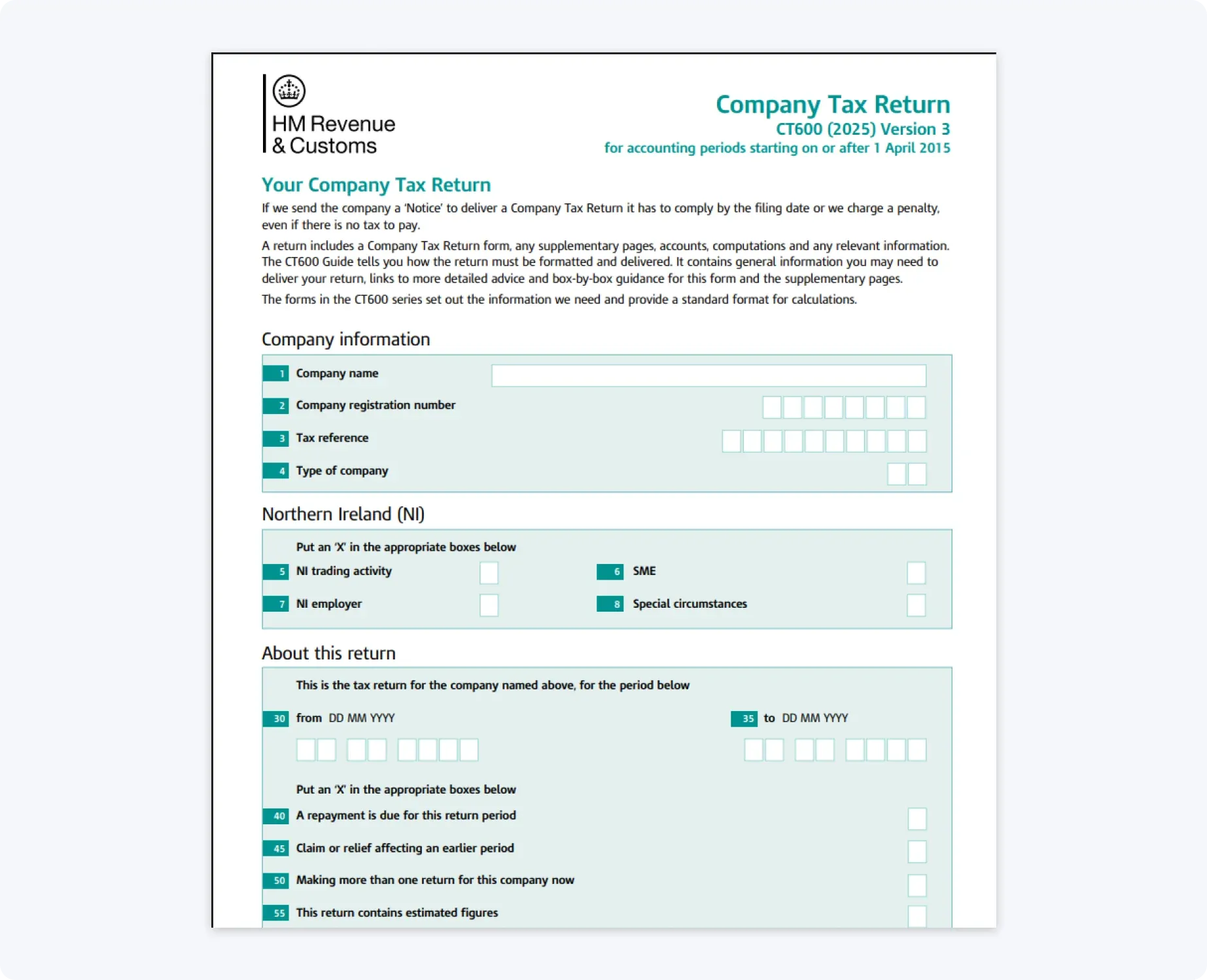
How to file:
- Use accounting software or HMRC’s online service
- Most companies use an accountant, but you can do it yourself with the proper tools
Don't confuse this with the payment deadline. Payment is due 9 months + 1 day after year-end; filing is due 12 months after year-end.
Penalties for late filing:
- 1 day late: £200 fine
- 3 months: Another £200 fine
- 6 months: HMRC estimates the tax and charges 10% of the unpaid amount
- 12 months: An additional 10% of unpaid tax
💡 Tip:
File as early as possible, especially if your profits are variable. You can amend a CT600 within 12 months if your situation changes.
Companies House filing requirements for LTDs
As a limited company, you’re legally required to submit specific information to Companies House every year. These filings are separate from your tax obligations with HMRC, but missing them can have serious consequences, including your company being struck off the register.
Step 1: File annual accounts
Deadline: Within 9 months of your ARD.
If it’s your first year in business: You get 21 months from incorporation to file your first accounts.
Here’s what to include:
- Balance sheet
- Profit and loss statement
- Notes to the accounts
- Director’s report (for larger companies)
How to file:
- Submit online at Companies House WebFiling
💡Tip:
If your company qualifies as a micro-entity, you can file simpler accounts.
Here’s a look at the penalties for late filing:
Annual accounts filing penalties
| Delay | Penalty |
| Up to 1 month | £150 |
| 1–3 months | £375 |
| 3–6 months | £750 |
| Over 6 months | £1,500 |
If you miss the deadline two years in a row, the penalty doubles.
Even if your company is dormant or not trading, you still have to file accounts.
Step 2: File the Confirmation Statement
Deadline: Every year, within 14 days of the anniversary of your incorporation (or the last Confirmation Statement filed).
The statement confirms:
- Registered office address
- SIC code (business activity)
- Details of directors and secretary (if applicable)
- Shareholder information
- Persons with Significant Control (PSCs)
You can file your application online through Companies House WebFiling or by post. Filing online costs £50, while submitting a paper application by post costs £110.
If you refuse to file, Companies House can start proceedings to strike off your company. You may also face director disqualification.
⚠️ Keep in mind:
Since 18 November 2025, directors and PSCs have to complete Companies House identity verification (through GOV.UK One Login or an Authorised Corporate Service Provider). They have to provide their personal code before a confirmation statement can be filed. Existing directors and PSCs must complete verification by their company's next confirmation statement deadline, or Companies House will reject the filing.
PAYE and payroll deadlines for LTDs
If your LTD company pays salaries, including to yourself as a director, you are required to operate PAYE and handle payroll reporting properly.
PAYE is the system HMRC uses to collect Income Tax and National Insurance from wages.
Step 1: Register as an employer
Deadline: You must register as an employer before your first payday.
Who needs to register: Any LTD company that pays salaries, including sole-director companies paying a director’s wage.
How to register:
- Visit the employer registering page
- Log in with your Government Gateway ID
- Complete the form with your company’s details
HMRC will send you a PAYE reference and Accounts Office reference by post
💡 Why this matters:
Registering ensures your company can legally run payroll and file RTI with HMRC. Without these references, you can’t meet your legal payroll obligations.
Step 2: Run monthly Payroll and submit RTI
Deadline: Submit the FPS to HMRC on or before each payday.
Here’s what you need to do each month:
- Use payroll software to calculate gross salary, Income Tax, employee and employer National Insurance
- Generate payslips for all employees and directors being paid
- Submit an FPS to HMRC using your payroll software
Example: If your monthly payday is the 25th, then the FPS must be submitted by the 25th of each month.
Recommended tools: Use HMRC-recognised payroll software like ANNA, Xero, QuickBooks, Sage, or FreeAgent to streamline the process.
Penalties: HMRC imposes fines for late RTI filings. These start from £100 per month and can increase depending on the number of employees. Frequent delays or errors may trigger compliance reviews.
Step 3: Pay PAYE and NIC to HMRC
Deadline: You must pay PAYE and NIC by the 22nd of each month if paying electronically, or by the 19th if paying by post.
Here’s what you have to pay:
- Income Tax withheld from salaries
- Employee National Insurance contributions
- Employer National Insurance contributions
How to pay:
- Log into your HMRC PAYE online account
- Make payment using bank transfer, Direct Debit, or the HMRC payment portal
- Always include your Accounts Office reference number when making payment
Why this matters: Late payments automatically accrue interest. Persistent delays may affect your company’s tax compliance status with HMRC.
💡 Tip:
Use your payroll software’s PAYE summary to double-check amounts due each month. Some directors choose to schedule a standing order around the 18th to avoid last-minute issues.
VAT registration and filing obligations
If your LTD company sells taxable goods or services, you may need to register for VAT. Even if your turnover is below the VAT registration threshold, voluntary registration can still be advantageous, especially if your business regularly incurs VAT on purchases or deals with VAT-registered clients.
Step 1: Check if you must register for VAT
When to register: You must register for VAT if your VAT-taxable turnover exceeds £90,000 (2026/27 threshold) in any rolling 12-month period.
Here’s what counts as taxable turnover:
- Income from the sale of goods or services subject to VAT
- Most consultancy, freelance, or professional services
- Online or physical product sales, even if only in the UK
How to check your turnover:
- Use a spreadsheet or accounting software to monitor monthly turnover
- Add up sales from the past 12 months on a rolling basis (not calendar year)
- If you expect to exceed £90,000 in a single 30-day period, you must register immediately
💡 Tip:
You can register for VAT voluntarily even if your turnover is below the registration threshold. This may be worthwhile if you want to reclaim VAT on business expenses, particularly if you're a startup with significant setup costs or mainly sell to other VAT-registered businesses.
Step 2: Register for VAT
Deadline: You must register within 30 days of exceeding the threshold or expecting to exceed it.
Here’s how to register:
- Go to the official VAT registration page
- Log in using your Government Gateway credentials
- Choose your VAT accounting scheme
- Submit your business details and wait for your VAT number
💡 Did you know?
You can use ANNA to register for VAT, simple and stress-free with expert guidance.
What happens next:
- You’ll receive a VAT certificate with your registration date and VAT number
- You must update your invoices to include your VAT number
- You may need to backdate VAT charges to the date you became liable
Why this matters: Delayed registration can result in backdated VAT liability that you’ll need to pay from your own funds if you didn’t charge customers VAT.
Step 3: Submit VAT returns and make payments
Deadline: Your VAT return is due one calendar month and 7 days after the end of each VAT quarter.
How to file:
- Submit using MTD-compliant software
- Keep digital records of all sales and expenses
- Ensure your return includes the correct VAT reclaimed and collected
Late VAT penalties:
HMRC uses a points-based penalty system
- One late return = 1 penalty point
- Reaching 4 points results in an automatic £200 fine
- Late payments also incur interest
💡 Tip:
Set up a dedicated VAT savings account and put aside around 20% of your VAT-able income. This helps ensure you have enough funds to pay your VAT bill when it's due.
ANNA’s smart pots automatically save for your tax bill every time you get paid, so you don’t have to set any reminders.
Salary and dividend planning for LTD directors
One of the main advantages of running a limited company is the ability to pay yourself through a combination of salary and dividends. When structured correctly, this can reduce your overall tax liability while ensuring you're contributing to your National Insurance record and pension.
Step 1: Decide on your director’s salary
When to review: At the start of the tax year or when business circumstances change.
Here’s a typical strategy for 2026/27:
Many directors pay themselves a salary equal to the NIC Primary Threshold, which is £12,570 per year, or £1,047.50 per month.
Why this amount works well:
- It keeps your salary within the tax-free Personal Allowance
- You don’t pay Income Tax, but still build qualifying years for your State Pension
- It reduces your Corporation Tax liability, as salary is a deductible business expense
How to pay it:
- Run your salary through PAYE each month
- File your FPS (Full Payment Submission) via payroll software
- Make any necessary NIC or PAYE payments if you exceed thresholds

Employer NIC liability kicks in above the Secondary Threshold (£5,000 for 2026/27). However, most LTDs qualify for the £10,500 Employment Allowance, unless the only employee is a director.
Step 2: Pay yourself dividends
When to issue dividends: Only from post-tax company profits, and only after preparing proper dividend paperwork.
Here are the dividend tax rates for 2026/27:
2026/27 Dividend tax rates
| Band | Taxable amount | Tax rate |
| Dividend Allowance | First £500 | 0% |
| Basic Rate | £501 – £37,700 | 10.75% |
| Higher Rate | £37,701 – £125,140 | 35.75% |
| Additional Rate | Over £125,140 | 39.35% |
How to pay dividends:
- Ensure your company has retained profits (after Corporation Tax)
- Hold a board meeting (even if you're the only director)
- Prepare a dividend voucher showing: recipient, date, amount
- Record it in your accounting software
Why dividends are tax-efficient:
- No National Insurance contributions apply
- You only pay dividend tax on amounts over the £500 allowance
- Paired with a low salary, it reduces total tax and NIC outgoings
You can’t pay dividends if your company doesn’t have post-tax profits. Doing so could result in unlawful dividends and director loan issues.
💡 Tip: Many directors take a £12,570 salary plus around £37,700 in dividends to stay within the basic rate tax band. This keeps your marginal rate low while still drawing a healthy income.
Step 3: File a Self Assessment tax return
Deadlines:
- Paper filing: 31 October 2027
- Online filing: 31 January 2028
You must file if:
- You received dividends over £500
- Your total income exceeded the Personal Allowance
- You’re a director (unless you have no other untaxed income)
What to include:
- Total salary paid via PAYE
- Total dividends received
- Any other personal income (e.g., rental income, interest)
Why this matters: HMRC uses your return to calculate any dividend tax due. Failing to declare dividends correctly can result in penalties or backdated tax demands.
How ANNA helps limited companies handle taxes with ease
If you run a UK limited company, staying compliant with HMRC and Companies House is non-negotiable, but it doesn't have to be stressful.
With ANNA, you can:
- Register for business taxes: Sign up for VAT, PAYE, and Corporation Tax when your company needs them.
- File taxes automatically: Submit VAT Returns, PAYE, and Corporation Tax to HMRC through recognised software.
- Keep your bookkeeping organised: Capture receipts, categorise expenses automatically, and stay on top of your records.
- Plan ahead for tax bills: Set money aside with Tax Pots and get reminders for upcoming deadlines.
- Run payroll with ease: Pay directors and employees, with automatic payslips and HMRC submissions.
- Create and send invoices: Generate professional invoices, accept payments, and track transactions in one place.
- Get tax support when you need it: Ask a question any time of day or night, ANNA’s team of professionals is always online.
Get started with ANNA today and never miss a tax deadline.
FAQ
Yes. Dormant companies must still file annual accounts and a Confirmation Statement with Companies House, even if they haven't traded.
Depending on the obligation, you may face late filing penalties, interest on unpaid tax, or both. Repeated failures can lead to higher penalties or further action from HMRC or Companies House.
No. You're not legally required to use an accountant, but many directors choose accounting software or professional support to help manage bookkeeping, payroll, tax returns, and statutory filings accurately.
Read the latest updates

![What Is Marginal Relief? [Everything You Need to Know]](https://storage.googleapis.com/anna-website-cms-prod/small_cover_3000_130_1ef44f67d1/small_cover_3000_130_1ef44f67d1.webp)





You may also like
![A Complete Guide to Business Taxes in the UK [Fully Explained]](https://storage.googleapis.com/anna-website-cms-prod/small_cover_3000_122_63df3f3b5d/small_cover_3000_122_63df3f3b5d.webp)
![A Guide to the UK Director’s Loan Interest Rate [Explained]](https://storage.googleapis.com/anna-website-cms-prod/small_cover_3000_126_926ef420c0/small_cover_3000_126_926ef420c0.webp)









Open a business account in minutes
