
Companies House Filing Fees Explained [2026 Guide]


Discover the Companies House filing fees so you can understand the costs, plan ahead, and manage your business compliance with confidence.


In this article
- Key points
- Why does Companies House charge fees?
- Why did the fees increase in 2026?
- Companies House fees for 2026
- Incorporation and registration
- Capital and other company filings
- Overseas entities
- The impacts of Companies House filing fees on UK businesses
- How to manage Companies House filing fees
- Take control of your Companies House costs with ANNA
- FAQ
Filing with Companies House might not be the most exciting part of running a business - but it’s one of the most important. Every company in the UK needs to file key documents to stay compliant, and that often means paying a small fee. The good news? It’s simple once you know what’s what.
In this guide, we’ll explain what Companies House filing fees actually cover, how much you’ll pay in 2026, and how to save money and stress when submitting your documents.
Key points
- Companies House fees increased again in February 2026 💷
The digital incorporation fee increased from £50 to £100, while the digital confirmation statement fee increased from £34 to £50. The changes took effect on 1 February 2026. - Digital filing is usually cheaper than paper filing 💻
Where both options are available, filing online or through software generally costs less than submitting paper forms. For example, incorporation costs £100 digitally compared with £124 on paper. - Your confirmation statement costs £50 a year
Every company, including non-trading and dormant companies, must file a confirmation statement at least once every 12 months. The digital filing fee is currently £50. - Some changes carry separate fees, while others don't
Changes such as a company name change or registering a charge can attract a separate fee. However, you can make many routine updates as part of your confirmation statement without an additional Companies House filing fee. - Compliance costs can be much higher if you miss deadlines ⚠️
Late filings can lead to penalties, and a company that is struck off may need to pay restoration fees and deal with additional administrative work. - Use ANNA to simplify company formation and compliance 🚀
ANNA helps businesses with company formation, filing reminders, bookkeeping, seamless invoicing, and tax administration, so you can track your business responsibilities in one place.
Why does Companies House charge fees?
Companies House is the UK’s official registrar of companies. It’s the body responsible for incorporating new companies, maintaining the public register, and ensuring compliance with filing obligations. It also makes company data publicly available. While it’s not a regulator in the sense of enforcing all business laws, it ensures the integrity of the corporate register.
Unlike a profit-driven entity, Companies House operates on a cost-recovery model: its filing fees are designed to cover the cost of delivering services (staff, technology, verification, enforcement). Because costs evolve with inflation, regulatory changes, technical upgrades, and enforcement demands, fees are periodically reviewed and sometimes significantly increased.
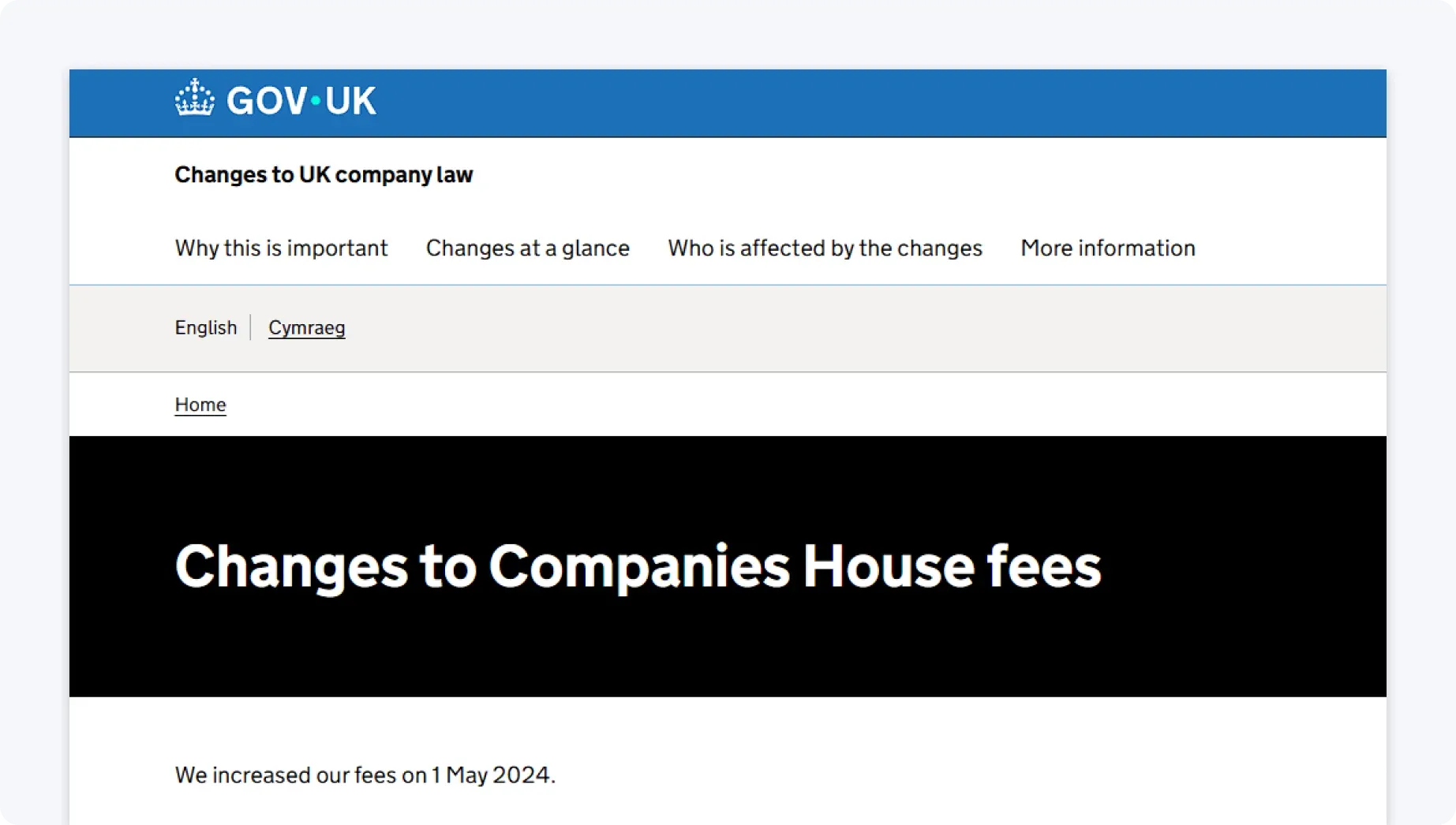
The latest major fee changes took effect on 1 February 2026. Companies House said the changes reflected the cost of delivering its services and the increased activity associated with implementing the Economic Crime and Corporate Transparency Act 2023.
Why did the fees increase in 2026?
The latest increase is part of the wider reform of Companies House.
The Economic Crime and Corporate Transparency Act 2023 gave Companies House additional responsibilities and powers, including stronger checks on company information and identity verification.
Companies House has also been developing its digital systems and strengthening the corporate register. These changes require additional resources, which is reflected in the fees businesses pay.
The February 2026 changes included some significant increases. The digital incorporation fee doubled from £50 to £100, while the digital confirmation statement fee increased from £34 to £50. At the same time, the digital voluntary strike-off fee fell from £33 to £13.
So while some fees have increased substantially, not every Companies House service has become more expensive.
Companies House fees for 2026
Here are some of the most common Companies House fees for UK companies from 1 February 2026:
Incorporation and registration
| Service | Digital/software | Paper |
| Company incorporation | £100 | £124 |
| Same-day incorporation | £156 | Not available |
| Change of company name | £20 | £30 |
| Same-day change of company name | £85 | Not available |
| Confirmation statement | £50 | £110 |
| Voluntary strike-off | £13 | £18 |
| Registration of a charge | £14 | £24 |
| Administrative restoration | Not available | £341 |
Some less common applications also have their own fees.
Capital and other company filings
| Service | 2026 fee |
| Reduction of capital by solvency statement | £20 |
| Same-day reduction of capital by solvency statement | £89 |
| Reduction of capital by court order | £20 |
| Application to remove personal details from the public register | £34 per document |
Companies House also charges fees for businesses and entities registered outside the UK.
For example, the 2026 fees for the Register of Overseas Entities (ROE) include:
Overseas entities
| Service | Online fee | Paper fee |
| Registration of an overseas entity | £250 | £528 |
| Annual update | £134 | £268 |
| Application for removal | £301 | £602 |
| Trust information application | £55 | Not available |
These fees are separate from the fees for incorporating or maintaining a UK limited company.
The impacts of Companies House filing fees on UK businesses
The February 2026 changes mean companies need to budget more carefully for some routine compliance costs.
Startups and new businesses
For a new company, the most obvious increase is the incorporation fee.
The digital fee is now £100, compared with £50 before 1 February 2026. Paper incorporation costs £124.
Although this is higher than in previous years, the Companies House fee is only one part of the cost of setting up a limited company. You may also need to budget for accounting software, professional advice, insurance, banking, and other business costs.
💡 Did you know?
If you're looking for a simpler way to set up your company, ANNA's company registration service can handle the formation process, along with your business account and other administrative tools.
Small and growing companies
For established companies, the £50 annual confirmation statement fee is one of the main recurring Companies House charges.
Additional costs can arise when you make certain structural changes, such as changing the company name, registering a charge, or applying for restoration.
The best approach is to understand which filings your company actually needs and avoid paying for unnecessary expedited services.
A more robust company register
The higher fees are also linked to broader changes at Companies House.
The organisation now has greater responsibilities around transparency, corporate information, and identity verification. These reforms are intended to improve the reliability of the public register and make it harder to use UK companies for fraudulent or criminal purposes.
For legitimate businesses, a more reliable register can make it easier to check the companies you work with and give customers, suppliers, and other businesses confidence.
How to manage Companies House filing fees
You can't avoid statutory Companies House fees when your company needs to pay them, but you can avoid unnecessary costs and make compliance easier.
1. File digitally whenever possible
Digital filing is generally cheaper than paper filing.
For example, company incorporation costs £100 online compared with £124 on paper, while a confirmation statement costs £50 digitally compared with £110 on paper.
Digital filing can also be faster, and it makes spotting missing information before submitting easier.
2. Check whether a change has a separate fee
Don't assume every company update costs extra.
Some information can be updated through the confirmation statement, while other changes require separate filings with their own fees.
Checking the relevant Companies House guidance before submitting can help you avoid unnecessary applications.
3. Avoid same-day services unless you need them
Same-day services cost more than standard filing.
For example, same-day incorporation costs £156, compared with £100 for standard digital incorporation. A same-day company name change costs £85 compared with £20 for a standard digital change.
If you don't have an urgent deadline, standard filing is usually the better-value option.
4. Check formation agents' fees
If you use an accountant, company formation agent, or another third party, check exactly what you're paying for.
There may be two separate costs:
- The official Companies House filing fee
- The provider's own service fee
Make sure you understand both before you start the application.
5. Double-check your filing
Review your information before submitting it.
Correcting mistakes may mean filing again or handling additional admin, depending on what needs to change.
If you're unsure about a filing, professional advice or a guided filing service can help you avoid mistakes.
6. Don't miss deadlines
Late filing can cost considerably more than the original filing fee.
For example, companies can face penalties for filing accounts late, while failing to file a confirmation statement can result in a fine of up to £5,000 and potentially lead to the company being struck off.
Keeping track of your confirmation statement, accounts, and other filing deadlines can help you avoid unnecessary costs.
7. Keep up with Companies House reforms
Companies House requirements continue to evolve as part of ongoing transparency and anti-fraud reforms.
By 2026, identity verification for directors and people with significant control (PSCs) is a standard compliance requirement, and companies are expected to ensure all relevant individuals are fully verified and kept up to date on the register.
Regularly review Companies House guidance and keep your company records accurate, as further changes to filing and compliance rules may continue to be introduced.
Take control of your Companies House costs with ANNA
Filing fees may have increased, but knowledge is power. Understanding what you’re paying, why fees have risen, and how to file smartly puts you ahead of the game.
From startups to established businesses, the message is clear: plan ahead, file digitally whenever possible, and bundle changes to reduce costs. Staying compliant doesn’t have to be stressful - it just takes a little organisation and the right tools.
That’s where ANNA comes in:
- Register your company digitally - pay only the service fee and skip unnecessary markups.
- Set up a business account instantly, linked directly to your filings.
- Get automated filing reminders for confirmation statements, annual accounts, and other compliance deadlines.
- Manage bookkeeping stress-free - ANNA helps with your VAT, corporation tax, and ensures you never miss a deadline.
- Access support 24/7 if you ever need help navigating filings or regulatory changes.
Sign up with ANNA and simplify your Companies House filing.
FAQ
Yes. Companies House can reject a filing if it doesn’t meet the legal or technical requirements. This can delay your company’s compliance and, if you resubmit the filing after a deadline, could result in penalties.
Yes. You don’t need an accountant to make Companies House filings. You can file directly through Companies House where an online service is available, or use compatible accounting or company secretarial software.
No. Identity verification is personal, so you can’t simply give your Companies House identity check to someone else. However, you can use an Authorised Corporate Service Provider (ACSP), such as an accountant or solicitor, to verify your identity on your behalf.
You only need to verify your identity once, but you must use your Companies House personal code for each relevant company role.
Read the latest updates


![What Is Marginal Relief? [Everything You Need to Know]](https://storage.googleapis.com/anna-website-cms-prod/small_cover_3000_130_1ef44f67d1/small_cover_3000_130_1ef44f67d1.webp)





![How to Get Proof of Address: Easy Ways Explained [2026 Guide]](https://storage.googleapis.com/anna-website-cms-prod/small_cover_3000_How_to_Get_Proof_of_Address_Easy_Ways_Explained_2025_Guide_6849892bd3/small_cover_3000_How_to_Get_Proof_of_Address_Easy_Ways_Explained_2025_Guide_6849892bd3.webp)
![Offshore Company Registration in the UK [2026 Guide]](https://storage.googleapis.com/anna-website-cms-prod/small_cover_3000_cdb14668f7/small_cover_3000_cdb14668f7.webp)


![How to Register a Company in the UK as a Foreigner [Guide]](https://storage.googleapis.com/anna-website-cms-prod/small_Cover_3000_How_to_Register_a_Company_in_the_UK_as_a_Foreigner_Complete_Guide_398ca25228/small_Cover_3000_How_to_Register_a_Company_in_the_UK_as_a_Foreigner_Complete_Guide_398ca25228.webp)
![Can a Virtual Office Be Used as a Registered Office? [Explained]](https://storage.googleapis.com/anna-website-cms-prod/a_GQ_Yenfc4b_H_Wi7dk_cover3000_Cana_Virtual_Office_Be_Usedasa_Registered_Officeor_Not_d64c9902e6/a_GQ_Yenfc4b_H_Wi7dk_cover3000_Cana_Virtual_Office_Be_Usedasa_Registered_Officeor_Not_d64c9902e6.avif)
![What is a registered Office Address? [Comprehensive Guide]](https://storage.googleapis.com/anna-website-cms-prod/small_a_Fwzx_Hfc4b_H_Wiu_QO_cover3000_Whatisa_Registered_Office_Address_cea053dd71/small_a_Fwzx_Hfc4b_H_Wiu_QO_cover3000_Whatisa_Registered_Office_Address_cea053dd71.webp)

![How to Find Company Registration Number in UK? [Complete Guide]](https://storage.googleapis.com/anna-website-cms-prod/small_a_FQ_263fc4b_H_Wij_LK_cover3000_Whatisa_Company_Registration_Numberand_Howto_Find_It_48e89b0b96/small_a_FQ_263fc4b_H_Wij_LK_cover3000_Whatisa_Company_Registration_Numberand_Howto_Find_It_48e89b0b96.webp)
![Can You Use a Dissolved Company Name? [Rules Explained]](https://storage.googleapis.com/anna-website-cms-prod/small_cover_3000_Can_You_Use_a_Dissolved_Company_Name_O_Co_Rules_and_Restrictions_Explained_3809e36850/small_cover_3000_Can_You_Use_a_Dissolved_Company_Name_O_Co_Rules_and_Restrictions_Explained_3809e36850.webp)
Open a business account in minutes
