





If your business provides employees or directors with benefits outside their salary – like a company car, private medical cover or a cheap loan – you almost certainly need to deal with the P11D form. It catches out small employers every year: late filing, missing benefits, or simply not knowing what to declare.

- In this article
- What is a P11D form?
- Quick P11D reference
- Which benefits should be reported in a P11D?
- How Benefits in Kind (BIK) tax is calculated
- Company cars and electric vehicles
- Company car BIK rates
- Payrolling benefits: the alternative to P11D
- Deadlines, filing and payment
- Completing the form: a practical overview
- Records HMRC expects you to keep
- Mandatory payrolling from April 2026: what changes now
- If you are an employee receiving a P11D
- Frequently asked questions
This guide covers the essentials: what the P11D is, which benefits it covers, how to work out what you owe, and how to file with HMRC without a last-minute scramble.
What is a P11D form?
A P11D is a form employers submit to HMRC each tax year to report benefits in kind (BIK) – non-cash perks provided to employees or directors that sit outside the payroll. The form reports the cash equivalent of those benefits to HMRC so the employee can be taxed correctly, usually through an adjustment to their tax code.
The employer fills the form in and submits it, and the employee receives a copy. It is not a form that employees complete themselves.
A related form, the P11D(b), is the employer's declaration of the total Class 1A National Insurance contributions (NICs) owed on the benefits reported. Think of the P11D as the per-employee record, and the P11D(b) as the summary covering every employee.
Quick P11D reference
| Who completes it? | The employer |
| Filing deadline | 6 July following the tax year end |
| What does it report? | Taxable benefits and expenses paid outside payroll |
| Who receives a copy? | Each employee who received benefits |
| Related form | P11D(b) – employer Class 1A NIC declaration |
The P11D is separate from a P60 (an employee's annual summary of pay and tax through payroll) and a P45 (issued when an employee leaves). These forms deal with payrolled income, and the P11D deals with everything else.
Which benefits should be reported in a P11D?
Not every workplace perk triggers a P11D entry. This form is for benefits that have a taxable cash equivalent and have not been processed through payroll.
Commonly reported benefits:
- Company cars and fuel for private use
- Private medical and dental insurance
- Director's loans or cheap loans (where interest is below HMRC's official rate)
- Living accommodation provided by the employer
- Assets made available for private use (laptops, equipment etc)
- Relocation expenses above the £8,000 exempt threshold
- Non-exempt staff entertainment and vouchers
- Professional subscriptions paid by the employer that benefit the individual
Benefits that don’t normally go on a P11D:
- Trivial benefits worth £50 or less per instance
- Mileage reimbursements within HMRC's approved rates
- Work-related training
- A single mobile phone per employee
- Employer pension contributions
Where HMRC has granted a formal exemption – or you have a PAYE Settlement Agreement (PSA) in place for certain expenses – those items are excluded, too. It’s worth checking what you already have, as many small employers are sitting on dispensations that save them a fair bit of paperwork.
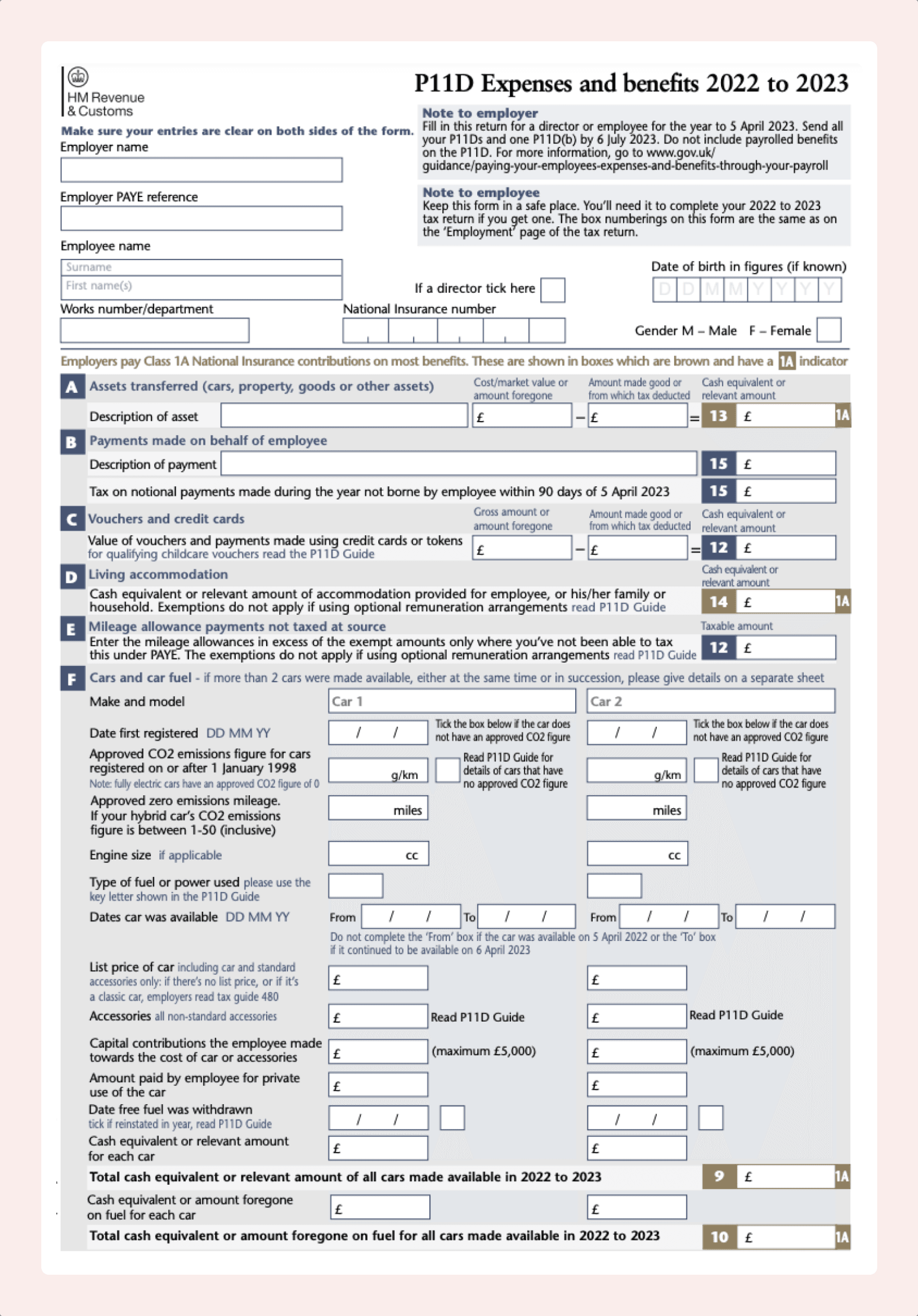 A sample P11D form (source: HMRC)
How Benefits in Kind (BIK) tax is calculated
Every benefit on the P11D has a cash equivalent – this is the value HMRC uses to work out what the employee owes. For most benefits, it’s simply what you paid, or the market value of what was provided. Company cars work differently (more on that below).
The cash equivalent is added to the employee's taxable income. They then pay income tax at their marginal rate – 20%, 40% or 45% – on that amount. This normally happens through a tax code adjustment, rather than a one-off bill.
As the employer, you pay Class 1A National Insurance at 13.8% on the total cash equivalent of benefits provided. This is reported and paid separately via the P11D(b), with payment due by 22 July.
Example: private medical insurance Your employee earns £35,000. You pay £1,200 per year for their health cover. Their taxable income becomes £36,200. As a basic-rate taxpayer, they owe an additional £240 in income tax – collected through their tax code. As the employer, you owe £165.60 in Class 1A NICs (£1,200 × 13.8%).
Company cars and electric vehicles
Company car benefits attract the most attention on any P11D – and for good reason.
The taxable value is based on the car's P11D value (list price including accessories, less any capital contribution from the employee) multiplied by a BIK percentage set by CO₂ emissions and fuel type.
Company car BIK rates
| Fuel type | BIK rate (2025/26) |
|---|---|
| Pure electric (EV) | 3% |
| Plug-in hybrid (low CO₂, depending on electric range) | 6–19% |
| Petrol or diesel (low CO₂) | 23%+ |
| Petrol or diesel (higher CO₂) | up to 37% |
Rates increase each year – always check HMRC's tables for the relevant tax year.
The 3% BIK rate for electric vehicles still makes EVs considerably cheaper to provide as company cars compared to petrol or diesel equivalents, even as rates begin to creep up. A home or workplace charger provided by the employer does not itself create a P11D liability, and HMRC does not class electricity as a fuel – so there is no fuel benefit charge on an electric company car.
If you pay for private fuel in a conventional company car, a fuel benefit charge applies. For 2025/26 it uses a fixed multiplier of £28,200, multiplied by the same BIK percentage as the car. Because the charge is triggered by any private fuel use regardless of mileage, many employers simply stop paying for private fuel and remove it mid-year using the relevant box on the P11D.
Payrolling benefits: the alternative to P11D
Most small employers do not realise you can payroll benefits in kind instead of reporting them on a P11D. Register with HMRC before the start of the tax year, and you can add the cash equivalent of a benefit to the employee's monthly payslip and deduct tax through PAYE in real time. No waiting for a tax code adjustment, and no raising individual P11D forms for those benefits (although the P11D(b) for Class 1A NICs still applies).
Most benefits can be payrolled. The main exceptions are living accommodation and beneficial loans, which must still be declared on a P11D. From April 2026 (just weeks away) payrolling becomes mandatory for most benefits. If you haven’t made the switch yet, now is the time.
Deadlines, filing and payment
| Obligation | Deadline |
|---|---|
| Submit P11D forms to HMRC | 6 July |
| Provide copies to employees | 6 July |
| Submit P11D(b) to HMRC | 6 July |
| Pay Class 1A NICs (electronically) | 22 July |
| Pay Class 1A NICs (by cheque) | 19 July |
P11Ds can be filed through HMRC's PAYE online service or via approved payroll software. Paper forms are technically still permitted but increasingly impractical. Always save your submission confirmation.
Late filing incurs a penalty of £100 per 50 employees for each month (or part month) the return is outstanding. Interest is added to late Class 1A NIC payments. If you spot an error after submitting, HMRC allows amendments – finding it yourself is far better than waiting for HMRC to spot your mistakes.
⚠️ Common mistakes to avoid
Small employers fall into the same traps year after year: forgetting to include benefits for directors (who count as employees for P11D purposes), reporting benefits gross when they should be net, misapplying the trivial benefits exemption above the £50 threshold, and missing the fuel benefit charge when private fuel has been provided. A quick review before you submit can save a lot of hassle (and money) later on.
Completing the form: a practical overview
Before you start, gather employee details, benefit start and end dates, invoices or policy documents, and any evidence of capital contributions. HMRC's P11D guidance and its company car tax calculator are both genuinely useful – there’s no need to guess at figures.
The form runs from sections A to N, each covering a category of benefit:
- Section D – living accommodation
- Section F – cars and car fuel
- Section G – vans and van fuel
- Section H – interest-free or low-interest loans
- Section I – private medical or dental insurance
- Section L – assets made available without transfer (private use of company assets)
- Section M – other benefits and expenses
Where a benefit has been provided through salary sacrifice, Optional Remuneration Arrangements (OpRA) apply. The taxable value is the higher of the normal cash equivalent and the salary given up. Company cars under OpRA salary sacrifice are a common area of confusion – it’s worth taking advice if the amounts are significant.
Records HMRC expects you to keep
HMRC can enquire into P11D returns for up to 6 years. Hold on to contracts, insurance documents, loan agreements, car records, and relevant invoices for at least that long. If a benefit changes mid-year (e.g. a car is returned, cover is cancelled) document the dates carefully. Getting the number of days right when apportioning a benefit is one of the more common calculation errors, and an easy one to avoid.
Mandatory payrolling from April 2026: what changes now
From 6 April 2026, payrolling of most benefits in kind becomes mandatory. For most employers, this means the end of individual P11D returns for employees. Benefits will be reported and taxed through payroll in real time.
The P11D(b) and Class 1A NICs are not going away – you will still report the total value of benefits and pay the associated NICs. But the per-employee P11D form, for the majority of businesses, will no longer be required after this tax year.
Living accommodation and employer-provided loans are expected to remain outside mandatory payrolling initially. HMRC has confirmed the change and further guidance is available on gov.uk.
If your payroll software does not yet support benefits payrolling, you need to get it sorted before 6 April. The switch also means updating employee communications – many staff don’t know how their tax code relates to their benefits, and payrolling changes how that tax gets collected.
📌 Act now, avoid issues later
The 2025/26 tax year is the last one for which most employers will need to file P11Ds for individual employees in the traditional way. Getting payrolling set up before 6 April means you can transition easily, rather than scramble. Check your payroll software, register with HMRC to payroll benefits, and let your employees know their payslips will look slightly different from April onwards.
If you are an employee receiving a P11D
Your employer must give you a copy of your P11D by 6 July. Check it carefully – wrong values and benefits you did not actually receive are not uncommon.
HMRC will usually adjust your tax code to collect the tax owed. If you complete a Self Assessment return, you will enter P11D values there too. Underpayments are typically collected through your code the following year, though larger amounts can result in a direct request to pay.
Didn’t get a P11D and think you should have? Start by checking with your employer. If that doesn’t resolve things, HMRC's helpline can advise on your options.
Tax rules and rates change. This article reflects the position as of the 2025/26 tax year. Always check the latest HMRC guidance or take professional advice for your specific circumstances.
Frequently asked questions
Does a company van go on a P11D?
Yes, if it is available for private use. The standard van benefit charge for 2025/26 is £4,020 (nil for zero-emission vans), with a separate van fuel benefit charge of £769. Vans are taxed at a flat rate rather than the percentage-of-list-price method used for cars. Note that from 6 April 2025, most double-cab pick-ups are now treated as cars rather than vans for BIK purposes.
Are employer-provided mobile phones reportable?
One mobile phone per employee is exempt, regardless of cost. A second phone – or one provided mainly for personal use – is not.
What about season ticket loans?
Loans totalling £10,000 or less across all outstanding loans to an employee in a tax year are exempt. Above that threshold, the interest benefit must be reported on the P11D.
What if a benefit comes from a third party, not directly from my employer?
Third-party benefits are generally reportable where there is an arrangement between the employer and the third party. Where there is no such arrangement, the third party may have its own reporting obligations under PAYE rules.
Read the latest updates


![What Is the Threshold for Making Tax Digital? [Guide]](https://storage.googleapis.com/anna-website-cms-prod/small_cover_3057_f0f2ffd268/small_cover_3057_f0f2ffd268.webp)


![Making Tax Digital for Freelancers [Complete 2026 Guide]](https://storage.googleapis.com/anna-website-cms-prod/small_cover_3000_25_15d6713572/small_cover_3000_25_15d6713572.webp)
![How to Sign Up for Making Tax Digital [A Detailed Guide]](https://storage.googleapis.com/anna-website-cms-prod/small_cover_3031_86f7f6f18a/small_cover_3031_86f7f6f18a.webp)
![MTD ITSA for Landlords [+6 Software Options Compared]](https://storage.googleapis.com/anna-website-cms-prod/small_cover_3025_77131ed4c8/small_cover_3025_77131ed4c8.webp)
![How to Choose the Best MTD Bridging Software [+Comparison]](https://storage.googleapis.com/anna-website-cms-prod/small_cover_3000_22_ba8f9dee9d/small_cover_3000_22_ba8f9dee9d.webp)
You may also like


![How to register for Corporation Tax in UK? [Step-by-step Guide]](https://storage.googleapis.com/anna-website-cms-prod/22391eac_9a5e_41e3_8d5a_61ccf331d395_2023_04_18_Corporation_tax_and_LTD_a9e5d074fa/22391eac_9a5e_41e3_8d5a_61ccf331d395_2023_04_18_Corporation_tax_and_LTD_a9e5d074fa.avif)


Open a business account in minutes
