
Top Company Formation Challenges [+How to Solve Them]


Explore top company formation challenges so you can avoid common mistakes, manage compliance, and set up your business with confidence.

In this article
Before you can sell a single product or sign your first client, there’s one not-so-glamorous step you have to tackle: forming your company.
Sounds simple, right? Register the name, fill out some forms, and boom — you’re a business owner. Well… not quite.
The reality is that setting up a company often comes with a few unexpected twists and turns.
On the positive side, once you know what to expect, things get a lot easier.
Read on to learn about the most common company formation challenges with practical tips to overcome them so you can start strong and avoid costly mistakes.
Key points
- Choose the right business structure early 💼
Your business structure affects your taxes, personal liability, admin responsibilities, and growth potential. Sole traders and partnerships are simpler to run, while limited companies offer stronger protection, better tax planning opportunities, and are often the preferred option for businesses looking to scale or attract investment. - Avoid common company registration delays ⏳
Many formation delays come from preventable mistakes such as choosing a restricted company name, submitting incomplete information, or failing identity verification checks. Checking everything carefully before applying can help you get your business up and running faster. - Put strong contracts and agreements in place 📄
Clear employment contracts and shareholder agreements help prevent disputes, protect business interests, and ensure everyone understands their responsibilities. Getting these documents right from the start can save significant legal and operational headaches later. - Stay on top of tax registrations and compliance 💷
Registering correctly for Corporation Tax, VAT, PAYE, and other HMRC requirements is essential. Missing deadlines or registrations can result in penalties, while proper tax planning helps protect cash flow and supports long-term business growth. - Use ANNA to simplify company formation and ongoing admin 🚀
ANNA combines company registration, a business account, bookkeeping, payroll, VAT filing, Self Assessment, and Corporation Tax tools on a single platform. This helps reduce paperwork, automate compliance tasks, and gives founders more time to focus on growing their business rather than managing admin.
Top company formation challenges you must know
Setting up a company in the UK isn’t all tea and scones. There are a few tricky bits you’ll want to know about before you make it official.
1. Choosing the right business structure
One of the first big decisions UK entrepreneurs have to make is choosing the right business structure.
The choice affects everything from how much tax you pay to how much risk you personally take on, and even how much admin lands on your desk.
| Structure | Liability | Taxation | Administration & Reporting | Best For |
| Sole Trader | Unlimited | Personal Income Tax | Simplest, no public filing | Solo entrepreneurs, low risk |
| Partnership | Unlimited shared | Personal Income Tax | Simple, requires a tax and partnership agreement | Small teams sharing responsibilities |
| Limited Liability Partnership (LLP) | Limited to the capital contributed | Personal Income Tax (self-assessed) | Registered entity, annual filings | Professions needing liability protection |
| Private Limited Company (Ltd) | Limited to share capital | Corporation Tax + personal tax on dividends/salaries | Public filings, comprehensive compliance | Growth-oriented, investment-ready |
1. Sole Trader
If you want to keep things super simple, becoming a sole trader might be the way to go.
But simplicity comes with a catch: you’re personally on the hook for everything, from debts to legal issues.
- Tax: Your profits are taxed as personal income (plus National Insurance), and rates can climb as you earn more.
- Admin: It’s easy to set up, no public accounts, and no Companies House registration needed.
- Best for: Freelancers, microbusinesses, or anyone running a low-risk solo operation who wants minimal paperwork.
2. Partnership
Running a business with one or more partners? A standard partnership might work for you. Just keep in mind that you all share responsibility, including debts and legal liabilities.
- Tax: Each partner pays personal income tax on their share of profits.
- Admin: You’ll need a partnership agreement and to file tax returns, but no Companies House filings are required.
- Best for: Small teams or professionals who trust each other and are happy to share financial and legal risks.
3. Limited Liability Partnership (LLP)
An LLP is like a regular partnership, but with a big bonus: your personal assets are generally protected if things go wrong.
- Tax: Members pay tax on their share of profits as personal income, not Corporation Tax.
- Admin: You’ll need to register with Companies House and follow more compliance steps than a standard partnership, but you get more legal and operational flexibility.
- Best for: Professional services firms or joint ventures that want the partnership vibe but with limited liability protection.
4. Private Limited Company (Ltd)
This is the go-to choice for many startups looking to grow and attract investment.
An Ltd company is its own legal entity, which means your personal finances are separate from the business.
- Tax: The company pays Corporation Tax on profits (19%–25% in 2025), and you pay personal tax on salaries or dividends, which opens up smart tax planning options.
- Admin: There’s more paperwork, and you must register with Companies House, file annual accounts, and follow statutory rules.
- Best for: Startups and growing businesses that want credibility, scalability, investor appeal, and strong liability protection.
✨ Good to know: Limited companies are generally seen as the most credible and scalable structure, and they’re usually the top pick if you’re planning to raise venture capital.
How to decide?
- Know your risk comfort zone: If protecting your personal assets is a top priority, you’ll probably want to steer clear of options with unlimited liability.
- Think about tax planning: Limited companies often give you more flexibility when it comes to managing taxes efficiently.
- Look ahead to your growth goals: If you’re aiming to scale or attract investors, a Ltd company can boost your credibility and open doors to funding.
- Be honest about admin workload: Bigger structures usually mean more reporting and bookkeeping responsibilities, so make sure you’re prepared for that.
It’s also smart to talk things through with a business advisor, accountant, or legal expert who can help tailor the decision to your specific plans, industry, and market.
An increasing number of startups and SMEs are opting for limited companies, thanks to the balance of liability protection, tax benefits, and room to grow.
Whatever you decide, investing time in research (and a bit of expert advice) now will pay off in the long run.
With ANNA, you can register your company online and have it set up on the same day, often within just a few hours.
Once your business is incorporated, your UK business account will be ready to use straight away.

If you’re unsure about any part of the registration process, we also offer guidance, from handling the paperwork and setting up your account to helping you organise VAT when it’s needed.
2. Dealing with bureaucratic slowdowns
Setting up a company in the UK is usually pretty quick. In most cases, Companies House can get your business registered online within 24 hours.
But sometimes, things don’t go quite as smoothly. A few common hiccups can slow everything down, delaying your official launch and pushing back your plans.
Here’s what can cause those frustrating hold-ups.
1. Company name rejections
Choosing a name isn’t about creativity, but it has to follow some strict rules. If your proposed name is too similar to an existing company, includes sensitive words, or could be considered offensive, Companies House will reject it.
That means you’ll need to come up with a new name and resubmit your application, which will add extra time to the process.
2. Missing or incomplete details
A surprisingly common cause of delays is simply not providing all the required information. Missing director or shareholder details, an incorrect registered office address, or missing authorisations, especially if your company name contains sensitive terms, can all lead to rejections and resubmissions.
3. New identity verification rules
From November 2025, new identity verification requirements for directors and individuals with significant control (PSCs) will be introduced to combat fraud. These extra checks are a positive step for security, but they also add more steps to the formation process and can extend waiting times.
4. Stricter rules on registered office addresses
You can no longer use a P.O. box.
Companies now need a genuine physical address that meets the new “appropriate address” criteria.
Non-compliance can even lead to your company being struck off, so getting this right from the start is the key.
How to minimise delays?
- Pre-check company name availability and restrictions before applying.
- Gather and thoroughly verify all required documentation to minimise errors.
- Submit applications early in the working day and avoid weekends and holidays.
- Stay updated on regulatory changes and prepare for identity verification steps.
- Consider professional formation services offering application pre-submission reviews to catch errors.
✨ If you opt for ANNA, you can use our free online Company Name Availability Checker to quickly see if your desired name is already taken.
In case it is, we’ll generate a few options based on your initial suggestions.
Search for your perfect company name
Also, we are an official Authorised Corporate Service Provider (ACSP), which means we’re approved to carry out the required identity checks on your behalf.
This is especially handy if you're registering a company through us: we’ll sort your identity check at the same time, all in one smooth process.
And with our Virtual Office service providing the same day scanning, email notifications and document storage, while keeping sensitive information out of the wrong hands.
3. Managing employment contracts and shareholder agreements
Taking the time to handle employment contracts and shareholder agreements properly is key to keeping everyone on the same page and avoiding legal headaches.
Clear contracts are the key to keeping your business running smoothly.
Without well-defined employment contracts, misunderstandings about roles, pay, or termination can quickly turn into disputes, especially with the upcoming ‘day one’ unfair dismissal rights in 2027.
Similarly, shareholder agreements help prevent deadlocks and conflicts over decisions, dividends, or share transfers.
Unclear agreements can hurt morale, trust, and productivity, while also making investors wary if governance looks shaky.
On top of that, failing to meet 2025 employment law requirements, from unfair dismissal to anti-harassment duties, exposes your business to fines, tribunal claims, and costly settlements.
What to include in contracts and agreements?
- Employment contracts: Clarity on roles and responsibilities
When it comes to employment contracts, the devil’s in the details, and getting them right can save a lot of headaches down the line. Here’s what to include:
- Job title and role: Be clear about the employee’s official title and main responsibilities to avoid confusion and set expectations from day one.
- Salary and benefits: Spell out pay, bonuses, pension contributions, and other perks so everyone knows exactly what they’re entitled to.
- Working hours and overtime: Clarify expected hours, breaks, overtime rules, and any flexible arrangements. It ensures fairness and helps comply with the Working Time Regulations.
- Probation period: Include the length and terms of any probation. It gives both sides a chance to see if the fit is right while offering legal protection.
- Notice periods: Define how much notice employees and employers need to give when ending employment. This makes transitions smoother and reduces surprises.
- Confidentiality and non-compete: Protect sensitive information and business interests, but make sure any restrictions are reasonable and enforceable.
- Disciplinary and grievance procedures: Outline fair processes for handling workplace issues or disputes, ensuring everyone’s rights are protected.
- Shareholders’ agreements: Keep things clear and avoid disputes
A solid shareholders’ agreement is all about setting expectations and preventing conflicts before they happen. Key points to cover include:
Ownership and share classes: Clearly specify who owns what, including different classes of shares and the associated rights, such as voting power and dividend entitlements.
Decision-making and voting: Explain how major decisions will be made and when you’ll need unanimity or a supermajority to move forward.
Roles and responsibilities: Define what founders and shareholders can do in day-to-day operations and governance, so everyone knows their powers and responsibilities.
Share transfer rules: Include provisions such as pre-emption rights, drag-along, and tag-along clauses to manage exits and protect minority shareholders.
Dispute resolution: Agree on ways to handle conflicts. Mediation or arbitration can stop problems from spiraling into costly legal battles.
Confidentiality and non-compete: Just like employment contracts, these clauses protect company secrets and ensure shareholders don’t compete unfairly.
4. Handling tax registration and obligations
Taxes can make setting up a company in the UK feel more complicated than it needs to be. Founders have to juggle multiple registrations, navigate tricky tax rules, and stay on top of strict deadlines.
Managing Corporate Tax, VAT, and PAYE can consume time and resources, slowing down your operations.
If you miss a step, you risk fines or penalties.
On the other hand, staying on top of tax compliance and planning efficiently helps protect cash flow and sets your business up for steady, sustainable growth.
How to do proper tax planning?
If you are a sole trader or a partnership, register as self-employed on the HMRC website.
For limited companies, register the company with Companies House and inform HMRC of your business start date.
Which legal structure is best for my UK startup based on risk and tax?
| Legal structure | Risk | Taxation |
| Sole trader | Unlimited personal liability | Income tax on all profits |
| Limited company | Limited personal liability (separate entity) | Corporation Tax + personal tax |
| Partnership | Joint liability among partners | Income tax on profits |
| LLP | Limited liability | Partners taxed personally |
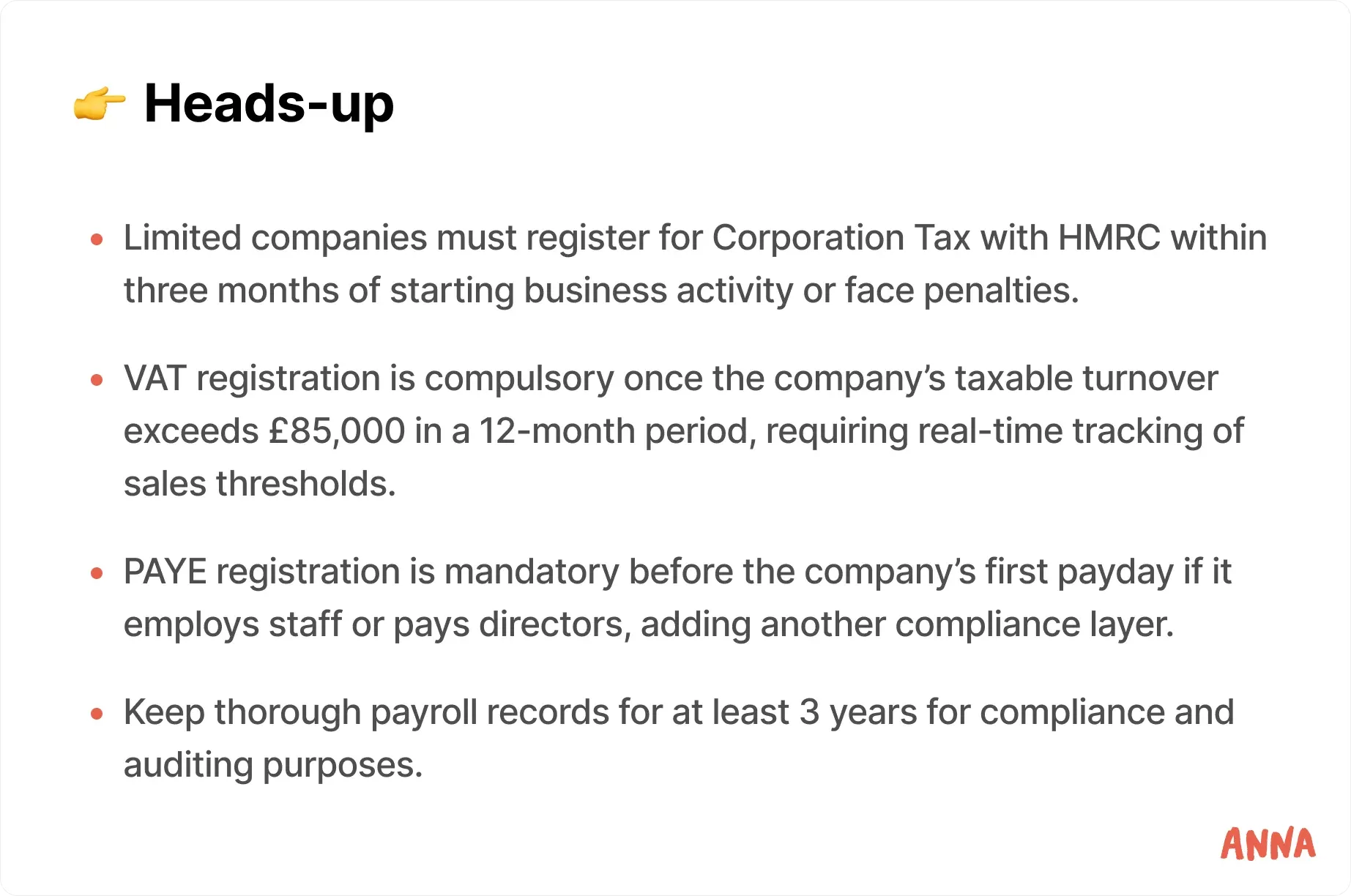
If you’re planning to hire staff, including yourself as a director, you’ll need to register as an employer with HMRC at least four weeks before the first payday.
Once registered, HMRC will send you a PAYE reference number and an Accounts Office reference number within about 5 to 20 working days.
You’ll need these to handle payroll and calculate wages, deduct Income Tax and National Insurance contributions, and pay employees on time.
You also need to submit monthly or quarterly payroll reports and payments to HMRC.
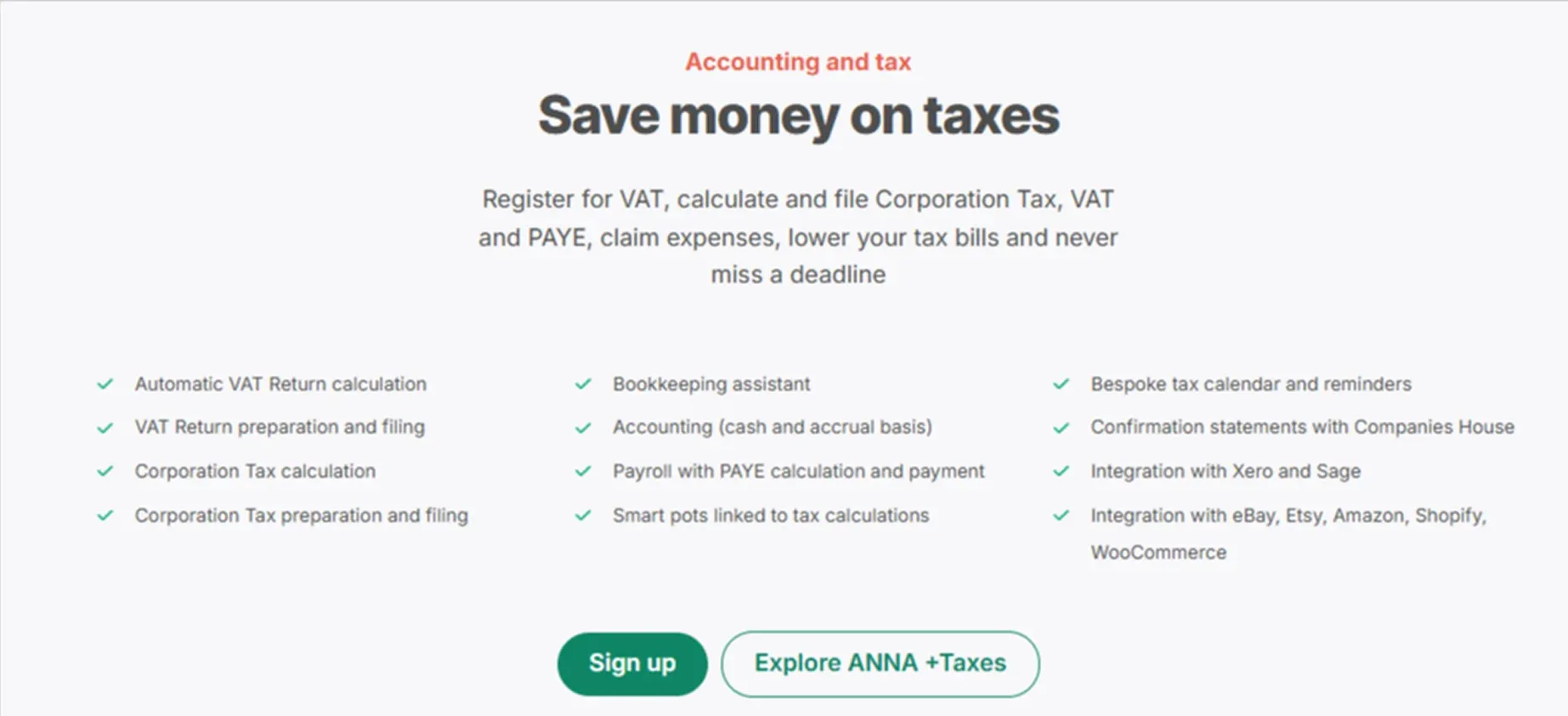
ANNA’s Auto Accountant has Payroll, VAT filing, Self Assessment, and Corporation Tax covered for you, so you don’t have to worry about complex documentation and paperwork.
You can start your business knowing you’ve ticked all HMRC’s boxes.
We also provide tools to calculate your payroll, set tax and payment reminders, automatically put aside a portion of money to cover upcoming tax payments, and keep your books tidy.
How to effectively solve company formation challenges with ANNA?
ANNA simplifies the entire process of setting up and running your business, from registering your company and opening a bank account to managing taxes.
Thus, we combine company registration, a business account, and built-in tax and admin tools into one seamless platform, ideal for a hassle-free setup.
With ANNA, you can:
✨ Set up and register a company with the Companies House fee on us within 1 day.
✨ Open a business account and connect your bank accounts to see your finances in one place, log your expenses, and organise money.
✨ Create quotes, send invoices and share your unique payment link or QR code for instant payouts.
✨ Automatically match receipts to transactions and categorise them for easy bookkeeping.
✨ Register for VAT, calculate and file Corporation Tax, Self Assessment, VAT and PAYE, claim expenses, and lower your tax bills.
Try ANNA today to simplify your company setup, so you can focus on growing your business instead of getting lost in paperwork.
Read the latest updates


![What Is Marginal Relief? [Everything You Need to Know]](https://storage.googleapis.com/anna-website-cms-prod/small_cover_3000_130_1ef44f67d1/small_cover_3000_130_1ef44f67d1.webp)




You may also like
![How to Register a Company in the UK as a Foreigner [Guide]](https://storage.googleapis.com/anna-website-cms-prod/small_Cover_3000_How_to_Register_a_Company_in_the_UK_as_a_Foreigner_Complete_Guide_398ca25228/small_Cover_3000_How_to_Register_a_Company_in_the_UK_as_a_Foreigner_Complete_Guide_398ca25228.webp)


![How to Find Company Registration Number in UK? [Complete Guide]](https://storage.googleapis.com/anna-website-cms-prod/small_a_FQ_263fc4b_H_Wij_LK_cover3000_Whatisa_Company_Registration_Numberand_Howto_Find_It_48e89b0b96/small_a_FQ_263fc4b_H_Wij_LK_cover3000_Whatisa_Company_Registration_Numberand_Howto_Find_It_48e89b0b96.webp)
![7 Benefits of Registering Your Company Online in the UK [+How to Do It Fast]](https://storage.googleapis.com/anna-website-cms-prod/small_cover30007_Benefitsof_Registering_ba507d0200/small_cover30007_Benefitsof_Registering_ba507d0200.webp)
![Offshore Company Registration in the UK [2026 Guide]](https://storage.googleapis.com/anna-website-cms-prod/small_cover_3000_cdb14668f7/small_cover_3000_cdb14668f7.webp)


![Can You Use a Dissolved Company Name? [Rules Explained]](https://storage.googleapis.com/anna-website-cms-prod/small_cover_3000_Can_You_Use_a_Dissolved_Company_Name_O_Co_Rules_and_Restrictions_Explained_3809e36850/small_cover_3000_Can_You_Use_a_Dissolved_Company_Name_O_Co_Rules_and_Restrictions_Explained_3809e36850.webp)

Open a business account in minutes
