
CT600 Form Guide: Corporation Tax Return Explained


Learn everything you need to know about CT600 form, understand how to file it correctly, meet key deadlines, and avoid costly mistakes.

In this article
- What is the CT600 form?
- Who needs to file a CT600?
- When are the deadlines for CT600?
- Corporation Tax rates
- Corporation tax rates (2026/27)
- The structure of CT600
- CT600 form and capital allowances
- CT600 form and R&D relief
- What else do you need to file alongside the CT600?
- Corporation Tax penalties
- CT600 late filing penalties (2026)
- ANNA – A simpler way to stay on top of Corporation Tax
- FAQ
A CT600 (Corporation Tax) form is the form UK limited companies use to report profits and calculate Corporation Tax for HMRC.
If you run a limited company in the UK, the CT600 is the form you use to tell HMRC what your company earned, what it owes in Corporation Tax, and how you came to that number.
Here's a detailed look at the CT600.
Key points
- Missing CT600 deadlines can be expensive 📅
Corporation Tax is usually due 9 months and 1 day after your accounting period ends, while the CT600 must be filed within 12 months of that date. Late filing penalties start at £200 and can increase significantly for repeated or prolonged delays. - Tax reliefs can reduce your Corporation Tax bill 💷
Capital allowances let you claim tax relief on business assets such as equipment and machinery, while R&D tax relief may be available if your company develops innovative products, software, or processes. - The CT600 requires supporting documents 📄
You must submit statutory accounts and a tax computation alongside the CT600. These documents show how you arrived at your taxable profit and usually have to be filed in iXBRL format. - ANNA helps you stay on top of Corporation Tax 🚀
ANNA automates bookkeeping, tracks tax liabilities, and reminds you about key deadlines to help you reduce admin work and lower the risk of filing errors.
What is the CT600 form?
The CT600 is HMRC's Company Tax Return form. You use it to report your company's taxable profits for an accounting period and calculate how much Corporation Tax is due.
HMRC doesn't calculate your Corporation Tax for you. Instead, your company must work out how much tax it owes, file a CT600 return, and make the payment by the relevant deadline.
That responsibility falls entirely on the directors, even if you use an accountant to prepare and submit everything.
✨ Working out the figure yourself? Our free corporation tax calculator shows what you owe, plus your payment and CT600 filing deadlines.
You can't send a paper CT600 unless you have an MTD exemption – or, in certain cases, when you're filing in Welsh. The form is filed online, either through HMRC's own Corporation Tax filing service or via commercial accounting software.
Who needs to file a CT600?
Any active UK-resident company needs to file a CT600 for each accounting period. That includes:
- Private limited companies (Ltd) and public limited companies (PLC)
- Members' clubs, associations, and societies with taxable income
- Co-operatives and community benefit societies
- Non-resident companies receiving UK property income or trading through a UK permanent establishment
Charities can have Corporation Tax liabilities, particularly on income that falls outside their charitable purposes, so they may need to file a return as well.
What about dormant companies?
A dormant company generally doesn't need to file a CT600, but you still need to tell HMRC it's dormant.
If HMRC has already issued a Notice to Deliver a Company Tax Return (form CT603), you have to respond and confirm the company's dormant status. Failing to do so could result in penalties.
When are the deadlines for CT600?
There are two separate deadlines to keep track of:
- Corporation Tax payment deadline: 9 months and 1 day after the accounting period ends
- CT600 filing deadline: 12 months after the accounting period ends
If your accounting period is longer than 12 months, which can happen in a company's first year, you'll need to file two separate CT600s. HMRC doesn't accept a single return covering more than 12 months.
🧠 Good to know:
Large companies pay differently. If your profits exceed £1.5 million (adjusted for associated companies), you'll typically pay Corporation Tax in quarterly instalments during the year rather than as a single payment afterwards.
Corporation Tax rates
These rates apply for the 2026/27 tax year:
Corporation tax rates (2026/27)
| Profit level | Corporation Tax rate |
| Up to £50,000 | 19% (small profits rate) |
| £50,001 to £250,000 | Tapered through marginal relief |
| Over £250,000 | 25% (main rate) |
These thresholds are divided between associated companies, so if your company has a sister company under common control, both thresholds are halved.
💡 Did you know?
ANNA's Auto Accountant can help you estimate your Corporation Tax bill based on your income and expenses throughout the year, so the payment deadline doesn't come as a surprise.
The structure of CT600
The form works through your company's finances section by section.
Here's a breakdown:
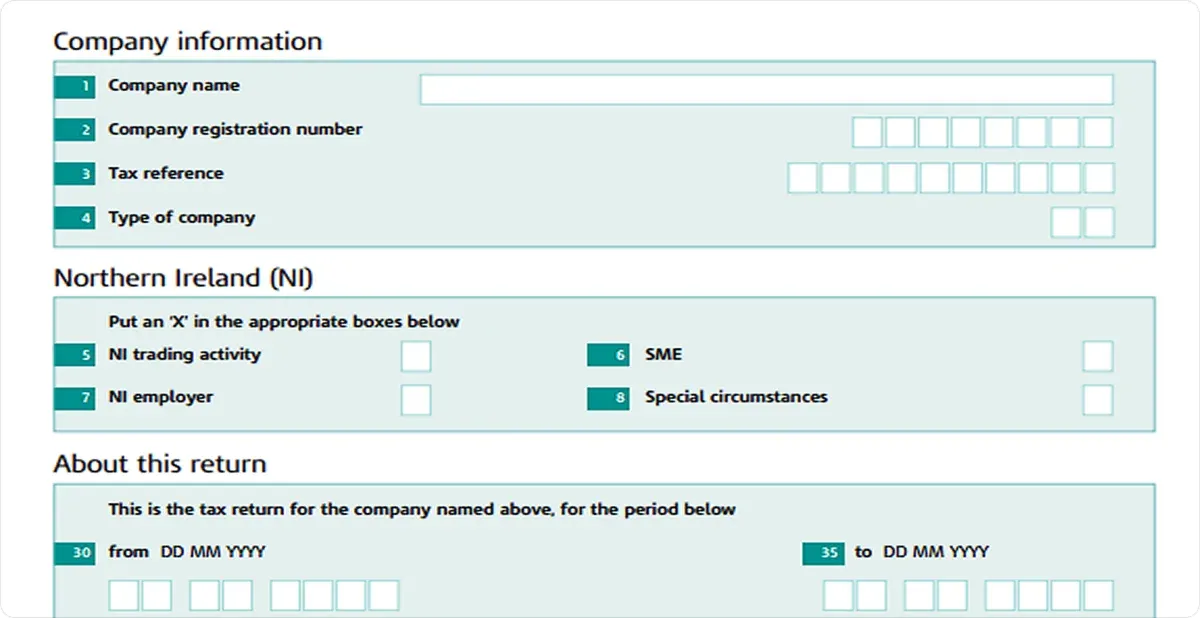
Company and period details
You'll start with your Unique Taxpayer Reference (UTR), company registration number, and the start and end dates of the accounting period.
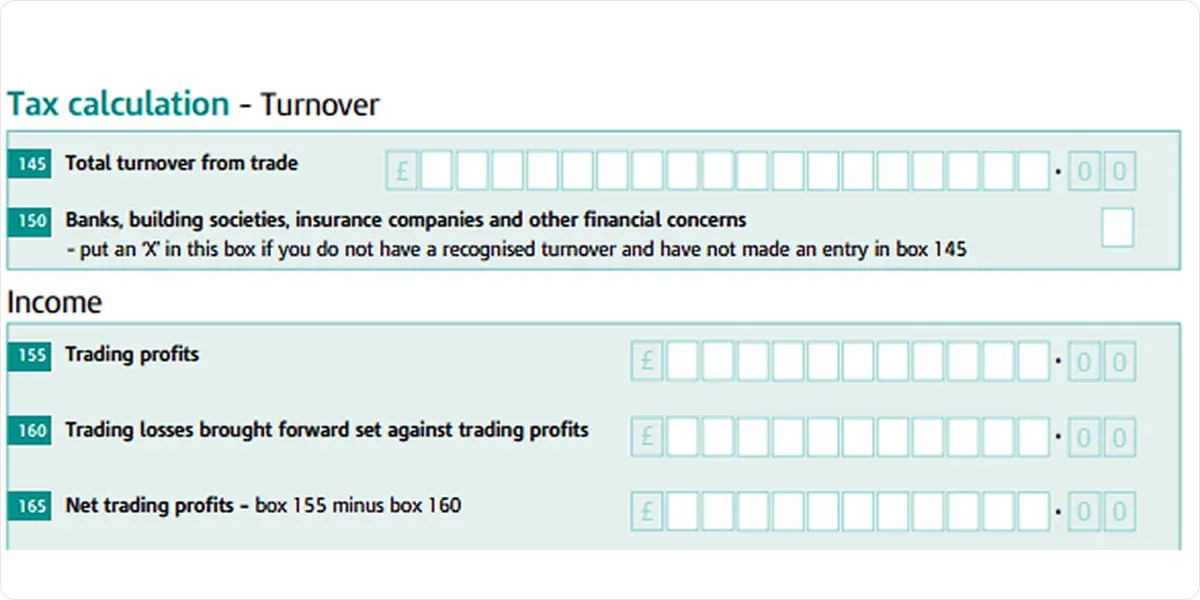
Trading profits
This is where you report the profit figure from your statutory accounts and adjust it for tax purposes. The two most common adjustments are:
- Adding back depreciation (which accounting standards require but HMRC doesn't accept as a deduction)
- Deducting capital allowances (HMRC's own system for writing down the cost of assets)
Property income, interest received, and gains from selling assets are all reported separately from trading profits. Each has its own rules on what counts and what you can offset against it.
Reliefs and deductions
This section covers items such as losses carried forward from previous years, group relief (where one group company transfers a loss to another), and Research and Development (R&D) tax relief, if your company qualifies.
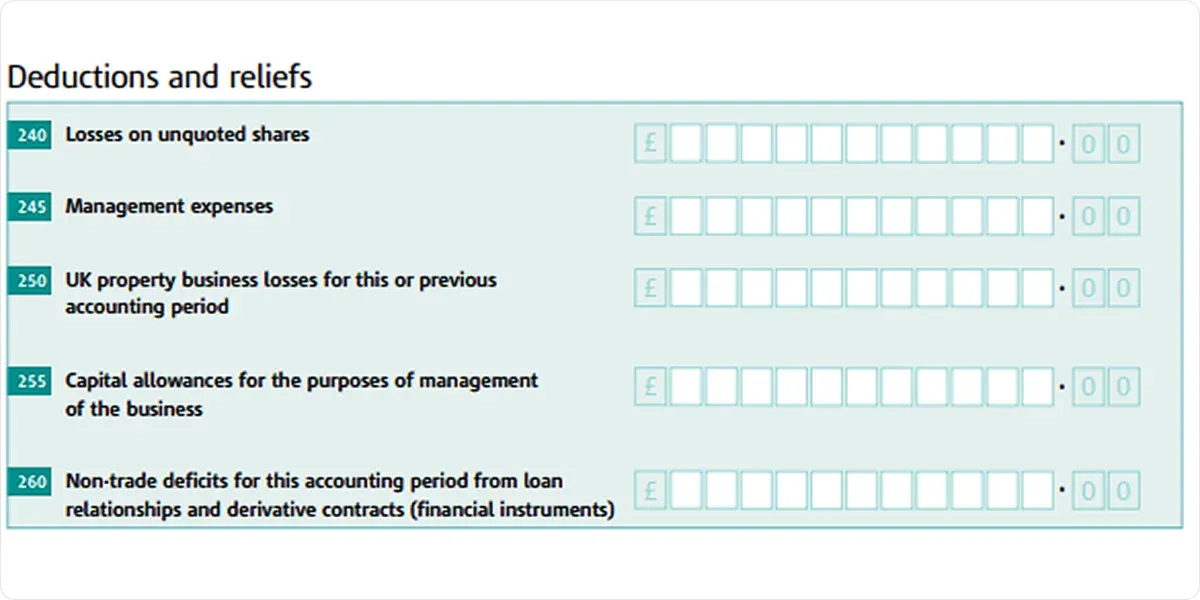
Reliefs aren't applied automatically – you have to claim them on the CT600. If you forget to claim something, you can amend the return within 12 months of the original filing deadline.
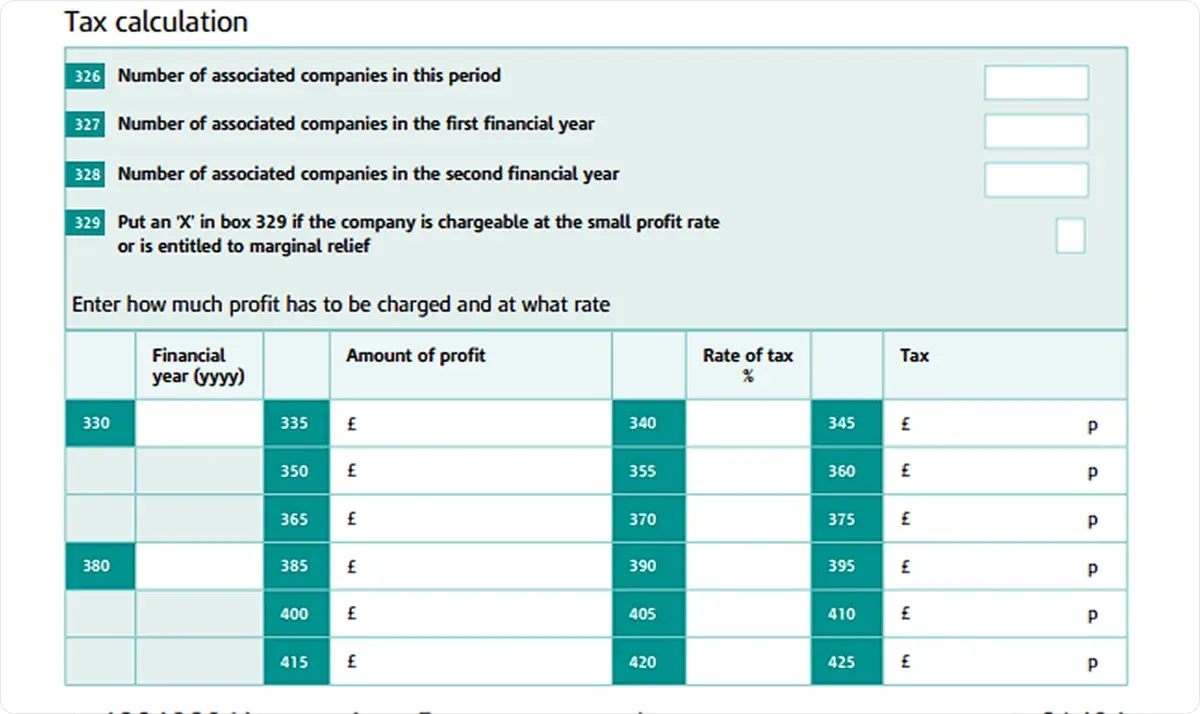
Tax calculation
The form totals your taxable profits, applies the appropriate rate, and calculates the tax due. Any payments already made on account are offset here.
CT600 form and capital allowances
Capital allowances allow companies to claim tax relief on certain business assets, reducing their taxable profits and Corporation Tax bill. They typically apply to items such as equipment, machinery, vehicles, and fixtures used in the business.
The Annual Investment Allowance (AIA) lets most companies deduct the full cost of qualifying plant and machinery in the year they buy it, up to a limit of £1 million per year. For most small businesses, this covers all of their qualifying expenses.
If you spend more than the AIA limit, you usually can't deduct the remaining cost all at once. Instead, you can claim tax relief gradually over several years through writing down allowances.
Most assets qualify for an 18% annual allowance, while certain assets, such as building electrical systems and long-life assets, qualify for a 6% annual allowance. The percentage is applied to the remaining value each year, so the amount you can claim decreases over time.
CT600 form and R&D relief
The R&D tax relief is designed to encourage companies to invest in innovation by reducing the tax cost of qualifying research and development activities.
If your company develops new products, processes, or software, or works to overcome scientific or technological challenges, you may be eligible to claim.
Since April 2024, most companies have used the merged R&D scheme. The relief generally works by providing an additional deduction against your taxable profits, reducing the amount of Corporation Tax you pay. If your company is loss-making, you may be able to convert part of the relief into a cash payment from HMRC instead.
The rules around qualifying activities and costs are detailed, so it's important to review claims carefully and ensure they meet HMRC's requirements.
What else do you need to file alongside the CT600?
The CT600 is just one part of the submission. You'll also need to include:
- Your statutory accounts (profit and loss account and balance sheet)
- A tax computation showing how you moved from accounting profit to taxable profit
Both need to be in the iXBRL format – a structured data format that HMRC can process. Most modern accounting software generates iXBRL files automatically, so you won't need to create them yourself.
If you're preparing the return manually, HMRC provides guidance on the minimum tagging requirements.
Corporation Tax penalties
HMRC updated its penalty system for CT600 filings from 1 April 2026, which is the first change in almost 30 years.
The fixed penalties have doubled: a return filed just one day late now costs £200 instead of £100, and filing more than three months late adds another £200 penalty.
The penalties apply based on your CT600 filing deadline, not your accounting period end date. So if your year ended in 2025 but your filing deadline falls after April 2026, the new higher amounts apply to you.
CT600 late filing penalties (2026)
| How late you filed | Penalty |
| 1 day late | £200 |
| 3 months late | Additional £200 (£400 total) |
| 6 months late | 10% of unpaid Corporation Tax |
| 12 months late | Further 10% of unpaid Corporation Tax |
The flat-rate penalties apply even if your company has no tax to pay. The percentage-based penalties at six and twelve months only kick in if Corporation Tax remains unpaid.
If you file late three years in a row, the stakes go up further: three consecutive late filings will now result in fines of £1,000 (if only slightly late) or £2,000 (if over three months late), even when no Corporation Tax is due.
On top of filing penalties, HMRC charges interest on any Corporation Tax paid late. The late payment interest rate is the Bank of England base rate plus 4%, currently around 7.25% to 8.25% per year, depending on the base rate at the time.
Interest is calculated daily from your payment deadline until payment is received.
Inaccurate returns carry a separate penalty, calculated as a percentage of the tax understated. The rate varies depending on whether the error was careless, deliberate, or hidden, and whether you flagged it before HMRC found it.
🧠 Good to know:
If you have a genuine reason for missing a deadline, such as a serious illness, a bereavement, or HMRC's own systems being unavailable when you tried to file, you can appeal within 30 days of receiving the penalty notice. HMRC does consider reasonable excuse claims, though there is a strict definition for them.
ANNA – A simpler way to stay on top of Corporation Tax
Filing the CT600 correctly and on time comes down to keeping your records up to date throughout the year.
For most directors, the admin pressure builds up in the weeks before the deadline, as they need to pull together invoices, reconcile accounts, and chase down figures that should have been logged months earlier.
ANNA keeps that work from piling up by tracking your income and expenses automatically from day one, so when it's time to prepare your return, the groundwork is already done.
Here's how ANNA helps with Corporation Tax:
- CT600 filing: Prepare and submit your Corporation Tax return through ANNA, helping you meet HMRC filing requirements without needing separate software.
- Real-time tax tracking: Monitor your estimated Corporation Tax liability as income and expenses are recorded, reducing the risk of unexpected tax bills.
- Automatic expense categorisation: Record and categorise transactions automatically, making it easier to prepare year-end accounts.
- Smart tax pots: Set aside money for Corporation Tax throughout the year to stay prepared for upcoming payments.
- Deadline reminders: Receive notifications about important Corporation Tax payment and filing deadlines before they arrive.
- Business account integration: Manage banking, bookkeeping, invoicing, and tax records in one place to reduce administrative work at year-end.
- Free director Self Assessment filing: File your personal Self Assessment tax return through ANNA at no additional cost. Even if you've already paid another provider, ANNA will refund the filing fee when you switch.
- 24/7 customer support: Get help whenever you need it, without being limited to standard business hours.
Open an ANNA account today and take the admin pressure out of Corporation Tax from the start.
FAQ
Yes, you can prepare and file the CT600 directly through HMRC's online Corporation Tax service.
Yes, within 12 months of the original filing deadline. If you missed a relief, made an error, or need to update a figure, you can submit an amended return through the same channel you used to file.
After that 12-month window closes, corrections go through HMRC's error or mistake relief process, which takes longer and can be more complicated.
File the CT600 anyway. Filing and payment carry separate deadlines and separate penalties, so missing the payment deadline doesn't excuse you from filing on time.
If you can't pay in full, you may be able to set up a Time to Pay arrangement with HMRC, which lets you pay in instalments.
If your CT600 is more than six months overdue, HMRC can issue a tax determination, which is their own estimate of what your company owes. Keep in mind that you can't appeal against a tax determination. You can only displace it by filing your actual return.
No. They are completely separate obligations. Your annual accounts are filed with Companies House, and your CT600 is filed with HMRC.
Read the latest updates

![What Is Marginal Relief? [Everything You Need to Know]](https://storage.googleapis.com/anna-website-cms-prod/small_cover_3000_130_1ef44f67d1/small_cover_3000_130_1ef44f67d1.webp)




You may also like
![How to Appeal a Corporation Tax Penalty? [Full Guide]](https://storage.googleapis.com/anna-website-cms-prod/small_cover_3000_117_200e96d871/small_cover_3000_117_200e96d871.webp)

![How to Pay Corporation Tax to HMRC [Complete Guide]](https://storage.googleapis.com/anna-website-cms-prod/small_cover_3000_83_26707beab4/small_cover_3000_83_26707beab4.webp)

![How to register for Corporation Tax in UK? [Step-by-step Guide]](https://storage.googleapis.com/anna-website-cms-prod/22391eac_9a5e_41e3_8d5a_61ccf331d395_2023_04_18_Corporation_tax_and_LTD_a9e5d074fa/22391eac_9a5e_41e3_8d5a_61ccf331d395_2023_04_18_Corporation_tax_and_LTD_a9e5d074fa.avif)


Open a business account in minutes
